Somewhere in every school there is a member of staff who is using an AI tool to survive their workload and is quietly afraid of being asked about it in public. There is another who suspects colleagues are using it and resents that nobody has said whether that is allowed. There is a pupil who used it for homework last night, a parent who has read a frightening article, and a leader who knows a policy is needed and has not had a spare afternoon since 2019.
This guide is for whoever has just been handed the job of sorting it out. Slightly overwhelmed is the correct response, and it is a temporary one.
The situation, in three facts #
None of these needs a view about whether AI is good or bad.
The tools are already in the building. In Public First's poll of 4,021 young people in England in August 2026, 75.6 per cent of secondary pupils thought their teachers definitely or probably use AI to plan lessons.12 Of the secondary pupils who use AI themselves, 39.6 per cent first used it aged 11 or younger.3 Whatever a school has decided, the school is using AI. The only question is whether it does so inside an agreed set of rules or a private one.
The rules have arrived. KCSIE 2026 names generative AI in its list of online risks: under contact, "harmful online interaction with other users or generative AI applications that simulate this", and under conduct, explicit images "including those generated using AI".45 JCQ defines AI misuse in assessed work, and Ofqual counted 100 cases of plagiarism involving AI in summer 2025.67 Data protection law never stopped applying: the ICO says that "in the vast majority of cases" the use of AI will involve processing likely to result in a high risk, which is the test for a DPIA.8 "We had not got round to it" was a serviceable answer in 2023. It is not one now.
Many schools have not said anything a pupil can repeat. In the same poll, only 21 per cent of secondary pupils said their school has rules on AI they could explain.9 That is usually reported as alarming. Read it as the baseline: a school with nothing written down yet is not behind some gold standard. It is standing with a great many others, and everything it does from here is progress.
A position is not a ban #
The word "governance" makes this sound like restriction. It is closer to the opposite.
Nobody is pushing a school either way. The DfE says schools and colleges "are free to make their own choices about the most suitable use cases for generative AI tools in their settings".10 Ofsted says there is no expectation that a school uses AI, and that what inspectors look at is "the quality of decision-making about AI".11 KCSIE 2026 does not require an AI policy, a named AI lead or a ban on AI tools.12
So the decision is the school's. And a school with no position does not have freedom. It has fear. Staff hide their use, which means nobody checks what the tools produce. Pupils get contradictory rules from different classrooms. The enthusiast and the sceptic fight it out by custom and practice. Every decision is made fresh, by whoever is asked, under time pressure, with no cover if it goes wrong. Silence does not prevent risk. It only prevents anyone from managing it.
A school with a position, even a cautious one, has something better: staff who know what is allowed and use it openly, pupils who are taught and not left to the internet, tools checked before they touch children's data, and a paper trail that answers hard questions before they are asked. Banning everything is a position. Allowing some things is a position. The only thing ruled out is having no position at all.
What "sorted" looks like #
Here is the destination, so the journey has a shape. A school that has this sorted holds five things, none of them exotic.
- A register of which AI tools are approved, for whom, and for what.
- A policy that answers real staffroom questions in plain English.
- Completed checks, which means DPIAs and vendor questions, for the tools that touch personal data.
- Training records showing staff and pupils have been taught.
- Review dates, so the whole thing stays alive as the ground moves.
That is the whole mountain: five documents and the habits that maintain them. None of it needs anyone to be technical, and none of it needs a lawyer. It needs people who run parts of a school and are used to turning statutory expectations into rotas, registers and briefing notes. This is the newest thing on that pile.
What this means for us
If only one thing gets done after reading this, find out what is in use in the school. Not to punish anyone: to see the real starting line. Govern the school as it is, not the one the policy imagines.
Where to go next #
Who regulates AI in schools: the map sets out which body asks for what. The policy builder asks ten questions and gives a draft policy in Word. The first hundred days puts the work in order across one term.
What changed in this guide #
November 2026: First published, written against the documents listed under Sources, each as read on the date its record shows.
Sources #
- AI in Education: polling tables (Public First for Seldon and Bunting), Public First, 22 September 2026
- Keeping children safe in education 2026, Department for Education, 7 July 2026
- AI Use in Assessments: Your role in protecting the integrity of qualifications, Joint Council for Qualifications, effective from September 2026
- Malpractice in GCSE, AS and A level: summer 2025 exam series, Ofqual, 11 December 2025
- Guidance on AI and data protection: accountability and governance implications, Information Commissioner's Office, 15 March 2023
- Generative artificial intelligence (AI) in education, Department for Education, 12 August 2025
- Inspection information for state-funded schools, for use from September 2026, Ofsted, 28 August 2026
Each source's record on the page shows the date it was read.
Free template
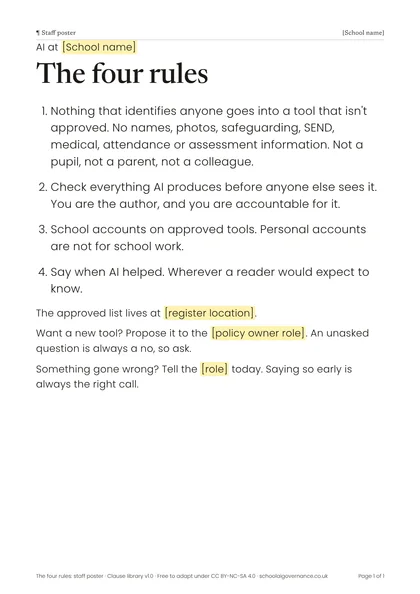
The four rules: staff poster
One A4 sheet for the staffroom and every new starter.
The facts behind this guide
Every claim above is numbered to one of these records. Each gives the source’s own words where it can, the paragraph or section, and the date it was last read.
- 01
Public First's poll for the report was an online survey of 4,021 people aged 11 to 24 in England, carried out from 18 to 27 August 2026, weighted by age, gender and region. "Secondary" means Years 7 to 11; "college" means college and school sixth form. Unweighted bases: 1,326 secondary pupils and 930 college and sixth form students unless a table says otherwise.
AI in Education: polling tables (Public First for Seldon and Bunting), methodology sheet. Dated 22 September 2026. Read 27 September 2026.
- 02
31.5 per cent of secondary pupils and 43.3 per cent of college students agree they are better at using AI than their teachers; 75.6 per cent of both think their teachers definitely or probably use AI to plan lessons (Table 66).
AI in Education: polling tables (Public First for Seldon and Bunting), Tables 111 and 66. Dated 22 September 2026. Read 27 September 2026.
- 03
39.6 per cent of secondary pupils who use AI first used it aged 11 or younger (AI users only, base 1,139).
AI in Education: polling tables (Public First for Seldon and Bunting), Table 9. Dated 22 September 2026. Read 27 September 2026.
- 04
Contact risk now includes harmful online interaction with generative AI applications that simulate other users. KCSIE does not use the words "chatbot" or "companion".
“being subjected to harmful online interaction with other users or generative AI applications that simulate this”
Keeping children safe in education 2026, paragraph 165. Dated 7 July 2026. Read 8 November 2026.
- 05
Conduct risk includes making, sending and receiving explicit images, including those generated using AI.
“making, sending and receiving explicit images, including those generated using AI”
Keeping children safe in education 2026, paragraph 165. Dated 7 July 2026. Read 8 November 2026.
- 06
JCQ calls it AI misuse where a student has used one or more AI tools, has not appropriately acknowledged that use, and has submitted work for assessment that is not their own. Its examples include copying or paraphrasing AI-generated content, using AI for parts of the assessment so the work does not reflect the student's own work, analysis, evaluation or calculations, failing to acknowledge AI used for information, guidance, planning or structure, failing to acknowledge AI used for spelling, punctuation and grammar, and using translation tools to turn work into English. JCQ says AI misuse constitutes malpractice.
AI Use in Assessments: Your role in protecting the integrity of qualifications, section 3, page 4 (edition effective from September 2026). Read 15 November 2026.
- 07
Ofqual counted 100 cases of plagiarism involving AI in summer 2025, 2.0 per cent of 5,025 student malpractice cases; phones and other devices accounted for 2,225.
Malpractice in GCSE, AS and A level: summer 2025 exam series, the release, tables 6.1 to 6.5. Dated 11 December 2025. Read 28 September 2026.
- 08
The ICO's AI guidance (updated 15 March 2023, under review) says that in the vast majority of cases the use of AI will involve processing likely to result in a high risk, so a DPIA is needed.
“in the vast majority of cases, the use of AI will involve a type of processing likely to result in a high risk to individuals' rights and freedoms”
Guidance on AI and data protection: accountability and governance implications, accountability and governance implications. Dated 15 March 2023. Read 28 September 2026.
- 09
Only 21 per cent of secondary pupils say their school has rules on AI they could explain.
AI in Education: polling tables (Public First for Seldon and Bunting), Table 67. Dated 22 September 2026. Read 26 September 2026.
- 10
The DfE says schools and colleges are free to make their own choices about the most suitable use cases for generative AI tools in their settings.
“are free to make their own choices about the most suitable use cases for generative AI tools in their settings”
Generative artificial intelligence (AI) in education, guidance text. Dated 12 August 2025. Read 28 September 2026.
- 11
Ofsted's inspection information for state-funded schools (for use from September 2026) says inspectors do not directly evaluate AI tools, there is no expectation that a school uses AI, and what they look at is the quality of decision-making about AI.
“the quality of decision-making about AI”
Inspection information for state-funded schools, for use from September 2026, the page, AI section. Dated 28 August 2026. Read 28 September 2026.
- 12
KCSIE 2026 does not require an AI policy, an AI strategy, a named AI lead, an AI training record, a stance on pupil use, or a ban on AI tools.
Keeping children safe in education 2026, whole document. Dated 7 July 2026. Read 8 November 2026.
Cite this guide
Wes (2026). Why every school now needs a position on AI. School AI Governance, reviewed 15 November 2026. https://schoolaigovernance.co.uk/guides/why-a-school-needs-an-ai-position
Free to use, adapt and share in education under CC BY-NC-SA 4.0. Each section heading carries its own link, so a reference can point at one part.