No single body regulates AI in schools in England. Five do, each from its own corner: the DfE, the ICO, JCQ, Ofqual and Ofsted. There is no single rulebook. In practice that means more documents, few of which properly cite the others, which does at least make them consistent with the technology they describe.
A school deciding whether staff may use a chatbot to help with reports is inside DfE guidance, safeguarding guidance and data protection law at once, and inside exam regulations too if the output touches assessed work. Joining them up is the school's job. This guide is the join.
The DfE: guidance, and a standard for the products #
The DfE's main document, Generative artificial intelligence (AI) in education, is labelled guidance and was last updated on 12 August 2025.1 Its position fits in two lines. Schools and colleges "are free to make their own choices about the most suitable use cases for generative AI tools in their settings".2 And any content AI produces "requires critical judgement to check for appropriateness and accuracy", with the quality of the final document remaining the responsibility of the professional who produced it and their organisation.3
The document with more edge is Generative AI: product safety standards. First published as expectations on 22 January 2025, they were renamed and extended on 19 January 2026, with new standards on cognitive development, emotional and social development, mental health, and manipulation.4 They are written for edtech developers and suppliers, not for schools. The DfE says only that schools and colleges "may also find them helpful in assessing which AI products are safe for use in education".5
Around those two sit the support materials. Using AI in education settings is four modules and a leaders' pack, free and ungated, updated on 19 May 2026.6 The digital and technology standards expect schools and colleges to be working towards six core standards by 2030, filtering and monitoring among them, and they are guidance too: the filtering and monitoring standard calls itself the DfE's recommended approach and says "You should already be meeting this standard".78
The Schools White Paper of February 2026 says the DfE will expect all AI tools used by schools to meet high standards of safety and quality. None of it is statutory, and none of it requires a school AI policy.9
KCSIE: statutory guidance, and what it does not ask for #
Keeping children safe in education 2026 is statutory guidance, in force from 1 September 2026. Schools and colleges in England must have regard to it; it does not have the force of law in itself.10 The 2026 edition was published in July and came into force on 1 September, giving schools the whole of August to digest it, a schedule clearly devised by someone who has never tried ringing a school office in August. Where it says "should", the guidance is to be followed unless there is good reason not to.11
It has no separate AI section. Two short paragraphs inside "Online safety" point schools that "choose to use Generative AI" to the DfE's guidance and its staff modules.12 AI appears in two of its four online risks, contact and conduct.13 And it says a review of filtering and monitoring should be carried out at least once every academic year, with a record kept of the checks.14
What it does not do matters as much. KCSIE 2026 does not require an AI policy, an AI strategy, a named AI lead, an AI training record, a stance on pupil use, or a ban on AI tools.15 The detail is in What KCSIE 2026 says about AI, deepfakes and filtering.
One neighbour belongs on the map beside it. The statutory RSHE guidance published in July 2025 applies to teaching from 1 September 2026, and its content on AI chatbots, deepfakes and AI-generated images sits in the secondary content only.1617
Data protection: the law, and a regulator with a new name #
This is the corner of the map that is law. For most personal data in a school the controller is, in the DfE's words, "the school or the multi-academy trust", and every maintained school, academy and college must appoint a data protection officer.1819
Two rules reach AI most often. A data protection impact assessment is required before processing that is likely to result in a high risk to people's rights and freedoms, in particular where new technologies are used, and the ICO's guidance says that in the vast majority of cases the use of AI will involve that kind of processing.2021 And since 5 February 2026 new articles of the UK GDPR govern automated decision-making: where a significant decision is taken with no meaningful human involvement, people must be told, be able to make representations, obtain human intervention and contest the decision.22
The regulator changed shape on 30 September 2026, when the office of Information Commissioner was abolished and its functions passed to the Information Commission. It is still known as the ICO.23 Regulations in force since 12 May 2026 require it to prepare a statutory code of practice on developing and using AI and automated decision-making, including guidance on children's personal data. No deadline is set.24
One instrument is often misread. Schools are not in scope of the ICO's Children's code; the duty to meet it falls on the providers of online services children are likely to use.25 The working detail is in Does your school need a DPIA for AI tools?
Qualifications: JCQ's rules bind the centre #
For an exam centre, the sharpest document on the map comes from JCQ. Its AI guidance was reissued in an edition effective from September 2026, in place of Revision Two of 30 April 2025.26
The hinge is the declaration of authentication. The candidate signs to confirm the work is their own and any AI use is acknowledged; the teacher confirms it too.27 The whole machinery of national assessment integrity rests, in the end, on a signature collected from a sixteen-year-old who mostly wants to get to lunch. Once the declaration is signed, the head of centre must notify the awarding body immediately of any suspected malpractice, and the awarding body decides the sanction.28
On detectors, JCQ is often misquoted. It does not require AI detection tools, and says their use "must form part of a holistic approach to considering the authenticity of students' work".29 Above the awarding bodies sits Ofqual, whose advice note of 27 April 2026 says detection tools "should be used as sources of evidence rather than as sole determinants".30 Ofqual has also asked exam boards for "a more rigorous approach to candidate and teacher authentication of work", and says AI may not be used as a sole marker in any assessments that are part of regulated qualifications.3132 The route, step by step, is in JCQ rules on AI in coursework.
Inspection: Ofsted looks at decisions, not tools #
Ofsted's inspection information for state-funded schools, for use from September 2026, says inspectors do not directly evaluate AI tools and that there is no expectation that a school uses AI. What they look at is "the quality of decision-making about AI".33
Two things that are not regulators of schools #
The EU AI Act does not regulate schools in England. Its Omnibus entered into force on 27 July 2026, and its high-risk rules for the group of systems that includes education apply from 2 December 2027. It touches schools here mainly through suppliers that also sell in the EU.34
And the reshuffle of responsibilities in Whitehall on 21 July 2026 moved online harms and AI strategy to other departments, but the DfE still leads on AI in schools.35
What it adds up to #
What this means for us
KCSIE does not require an AI policy, and the DfE leaves the choices to schools. What three of these documents do ask is for AI to be written into something the school already holds. The centre's malpractice policy must acknowledge the use of AI: what it is, when it may be used, how it is acknowledged, the risks, and how misuse is treated. The privacy notice must include how any data is collected, processed and stored by generative AI tools. And the child protection policy should cover the making or sharing of nudes and semi-nudes, including those generated using AI.363738
Check those three first. A policy is still worth writing, because it is where the decisions Ofsted looks at get written down, but it is the school's choice and not anyone's rule. The map is complicated. The list of things to do is not.
What moves next #
Three things on this map are known to be moving. The DfE has promised that later in 2026 ministers will consult on new independent safety certification for some types of technology used in schools, including generative AI and filtering and monitoring products.39 The ICO's statutory code on AI has no date. And the DfE's consultation response already refers to "KCSIE 2027"; a new edition in force on 1 September 2027 would follow the usual annual cycle, though that timing is an inference and not an announcement.40
Each change is recorded on What's changed when it has been read against the source.
What changed in this guide #
November 2026: First published, written against the documents listed under Sources, each as read on the date its record shows.
Sources #
- Generative artificial intelligence (AI) in education, Department for Education, 12 August 2025
- Generative AI: product safety standards, Department for Education, 19 January 2026
- Using AI in education settings: support materials, Department for Education (developed by Chiltern Learning Trust and the Chartered College of Teaching), 19 May 2026
- Meeting digital and technology standards in schools and colleges, Department for Education, 16 September 2026
- Filtering and monitoring standards for schools and colleges (Meeting digital and technology standards in schools and colleges), Department for Education, 16 September 2026
- Every child achieving and thriving (Schools White Paper), Department for Education, 27 April 2026
- Keeping children safe in education 2026, Department for Education, 7 July 2026
- Relationships education, relationships and sex education (RSE) and health education (statutory guidance), Department for Education, July 2025, for teaching from 1 September 2026
- Data protection in schools, Department for Education, 9 July 2026
- UK GDPR, Article 35: Data protection impact assessment, legislation.gov.uk
- Guidance on AI and data protection: accountability and governance implications, Information Commissioner's Office, 15 March 2023
- UK GDPR, Articles 22A to 22D: automated decision-making, legislation.gov.uk, 5 February 2026
- ICO governance changes confirmed for 30 September 2026, Information Commissioner's Office, 17 September 2026
- Regulations requiring the ICO to prepare a code of practice on AI and automated decision-making, SI 2026/425, legislation.gov.uk, 16 April 2026
- The Children's code and education technologies (edtech), Information Commissioner's Office
- AI Use in Assessments: Your role in protecting the integrity of qualifications, Joint Council for Qualifications, effective from September 2026
- Instructions for conducting non-examination assessments (GCE and GCSE) 2026/27, Joint Council for Qualifications, 1 September 2026 to 31 August 2027
- Suspected Malpractice: Policies and Procedures, Joint Council for Qualifications, effective from September 2026
- Artificial intelligence malpractice and assessment: advice note, Ofqual, 27 April 2026
- Letter to exam board chief executives from the Chief Regulator, Ofqual, 2 March 2026
- Ofqual's approach to regulating the use of artificial intelligence in the qualifications sector, Ofqual, 16 July 2026
- Inspection information for state-funded schools, for use from September 2026, Ofsted, 28 August 2026
- AI Omnibus enters into force, European Commission, 31 July 2026
- Written statement HLWS298, 21 July 2026 (machinery of government changes), UK Parliament, 21 July 2026
- General Regulations for Approved Centres 2026/27, Joint Council for Qualifications, 2026/27
- Data protection in schools: Generative artificial intelligence (AI) and data protection in schools, Department for Education, 23 March 2026
- New guidance on screen use for children aged 5 to 16 (press notice), Department for Education, 10 September 2026
- Keeping children safe in education 2026: government consultation response, Department for Education
Each source's record on the page shows the date it was read.
Free template
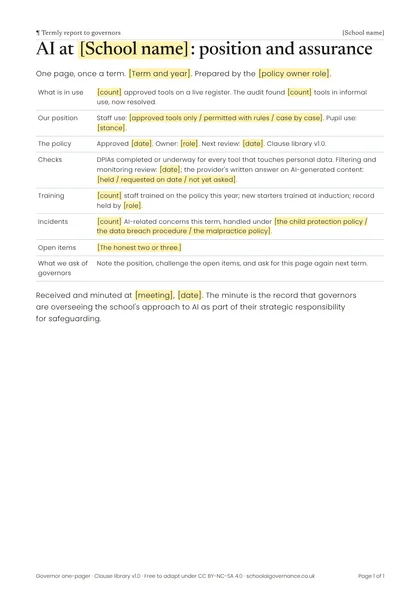
Governor one-pager
One page, once a term: what is in use, the position, the policy, the checks, the training, and the open items.
The facts behind this guide
Every claim above is numbered to one of these records. Each gives the source’s own words where it can, the paragraph or section, and the date it was last read.
- 01
"Generative artificial intelligence (AI) in education" is labelled guidance, first published 29 March 2023 and last updated 12 August 2025. It is not a policy paper and was not updated in January 2025.
Generative artificial intelligence (AI) in education, publication page. Dated 12 August 2025. Read 28 September 2026.
- 02
The DfE says schools and colleges are free to make their own choices about the most suitable use cases for generative AI tools in their settings.
“are free to make their own choices about the most suitable use cases for generative AI tools in their settings”
Generative artificial intelligence (AI) in education, guidance text. Dated 12 August 2025. Read 28 September 2026.
- 03
Any content produced by generative AI requires critical judgement to check for appropriateness and accuracy, and the quality of any final document remains the responsibility of the professional who produced it and their organisation.
“Any content produced requires critical judgement to check for appropriateness and accuracy”
Generative artificial intelligence (AI) in education, guidance text. Dated 12 August 2025. Read 28 September 2026.
- 04
The DfE's product rules for generative AI are now "Generative AI: product safety standards". First published as expectations on 22 January 2025, they were renamed and extended on 19 January 2026 with new standards on cognitive development, emotional and social development, mental health, and manipulation.
“to include new standards on cognitive development, emotional and social development, mental health, and manipulation”
Generative AI: product safety standards, publication page, change history. Dated 19 January 2026. Read 28 September 2026.
- 05
The standards are written for edtech developers and suppliers; the DfE says schools and colleges may also find them helpful in assessing which AI products are safe for use in education. That is softer than "schools can use them to judge what is safe to buy".
“These standards are for edtech developers and suppliers to schools and colleges. Schools and colleges may also find them helpful in assessing which AI products are safe for use in education.”
Generative AI: product safety standards, introduction. Dated 19 January 2026. Read 28 September 2026.
- 06
The DfE's "Using AI in education settings" materials are four modules and a leaders' pack, developed by the Chiltern Learning Trust and the Chartered College of Teaching, first published 10 June 2025 and updated 19 May 2026. They are free, ungated, under the Open Government Licence, and the DfE says they can also be adapted.
“can also be adapted”
Using AI in education settings: support materials, collection page. Dated 19 May 2026. Read 8 November 2026.
- 07
Schools and colleges are expected to be working towards meeting six core digital and technology standards by 2030, filtering and monitoring among them.
“working towards meeting 6 core standards by 2030”
Meeting digital and technology standards in schools and colleges, collection page. Dated 16 September 2026. Read 27 September 2026.
- 08
The filtering and monitoring standard is guidance ("DfE's recommended approach"), not statute, and says schools should already be meeting it. The 2030 date applies to the set of six core digital standards as a whole.
“You should already be meeting this standard”
Filtering and monitoring standards for schools and colleges (Meeting digital and technology standards in schools and colleges), the core standard. Dated 16 September 2026. Read 28 September 2026.
- 09
The Schools White Paper (23 February 2026, corrected 27 April) commits the DfE to expect all AI tools used by schools to meet high standards of safety and quality; to build on the content store in 2026; to build sovereign education benchmarks with an AI Safety and Pedagogy Taskforce; a data spine for pupil records; a digital and data skills pathway for the education workforce; AI tutoring tools available to schools by the end of 2027; and an additional £23 million for the EdTech Impact Testbed. None of it is statutory or requires a school AI policy.
“We will expect all AI tools used by schools to meet high standards of safety and quality.”
Every child achieving and thriving (Schools White Paper), chapter 7 (chapter 5 for the Teacher Training Entitlement). Dated 27 April 2026. Read 27 September 2026.
- 10
KCSIE 2026 is statutory guidance, in force from 1 September 2026. Schools and colleges in England must have regard to it; it does not have the force of law in itself.
“must have regard to it”
Keeping children safe in education 2026, About this guidance, page 5. Dated 7 July 2026. Read 8 November 2026.
- 11
In KCSIE, "should" means the guidance is to be followed unless there is good reason not to. It is not the same as "must".
“unless there is good reason not to”
Keeping children safe in education 2026, About this guidance, page 5. Dated 7 July 2026. Read 8 November 2026.
- 12
KCSIE 2026 has no separate AI section. Two short paragraphs inside "Online safety" point schools that choose to use generative AI to the DfE's guidance and its online staff modules.
“choose to use Generative AI”
Keeping children safe in education 2026, paragraphs 167 and 168. Dated 7 July 2026. Read 8 November 2026.
- 13
Paragraph 165 sorts online risk into four areas: content, contact, conduct and commerce. AI appears in two of them, contact and conduct, not in all four.
Keeping children safe in education 2026, paragraph 165. Dated 7 July 2026. Read 8 November 2026.
- 14
Governing bodies and proprietors should ensure that a review of the effectiveness of filtering and monitoring is carried out at least once every academic year, by the SLT member responsible for filtering and monitoring with the support of the DSL and IT support, covering all internet-connected devices in all relevant locations, with a record kept of the checks. This is "should", and the consultation response says it adds no new requirement.
“ensure that a review of their effectiveness is carried out at least once every academic year”
Keeping children safe in education 2026, paragraph 173. Dated 7 July 2026. Read 8 November 2026.
- 15
KCSIE 2026 does not require an AI policy, an AI strategy, a named AI lead, an AI training record, a stance on pupil use, or a ban on AI tools.
Keeping children safe in education 2026, whole document. Dated 7 July 2026. Read 8 November 2026.
- 16
The statutory RSHE guidance published in July 2025 applies to teaching from 1 September 2026.
Relationships education, relationships and sex education (RSE) and health education (statutory guidance), publication page, updated 1 September 2026. Dated July 2025. Read 8 November 2026.
- 17
The RSHE content on AI chatbots, deepfakes and AI-generated images sits in the secondary content only. Anywhere the book or hub says pupils are taught about AI chatbots through RSHE should say secondary pupils or pupils of secondary age.
Relationships education, relationships and sex education (RSE) and health education (statutory guidance), pages 15 to 17 (secondary); primary content checked. Dated July 2025. Read 8 November 2026.
- 18
For most personal data in a school the controller is, in the DfE's words, the school or the multi-academy trust.
“the school or the multi-academy trust”
Data protection in schools, Responsibilities. Dated 13 November 2026. Read 15 November 2026.
- 19
Every maintained school, academy and college must appoint a data protection officer, because public authorities must designate one (UK GDPR Article 37(1)(a)).
Data protection in schools, Role of data protection officers (with uk-gdpr-article-37). Dated 13 November 2026. Read 15 November 2026.
- 20
A DPIA is required before processing that is likely to result in a high risk to people's rights and freedoms, in particular where new technologies are used. It is not required before every tool that processes pupil data.
“in particular using new technologies”
UK GDPR, Article 35: Data protection impact assessment, Article 35(1). Read 28 September 2026.
- 21
The ICO's AI guidance (updated 15 March 2023, under review) says that in the vast majority of cases the use of AI will involve processing likely to result in a high risk, so a DPIA is needed.
“in the vast majority of cases, the use of AI will involve a type of processing likely to result in a high risk to individuals' rights and freedoms”
Guidance on AI and data protection: accountability and governance implications, accountability and governance implications. Dated 15 March 2023. Read 28 September 2026.
- 22
Since 5 February 2026, UK GDPR Articles 22A to 22D (inserted by section 80 of the Data (Use and Access) Act 2025) govern automated decision-making. A significant decision is one with a legal or similarly significant effect on the person; a decision is solely automated when there is no meaningful human involvement in taking it. People must be told, be able to make representations, obtain human intervention and contest the decision; stricter limits apply to special category data.
“no meaningful human involvement in the taking of the decision”
UK GDPR, Articles 22A to 22D: automated decision-making, Articles 22A to 22D; commencement by SI 2026/82, regulation 2(j). Dated 5 February 2026. Read 28 September 2026.
- 23
On 30 September 2026 the office of Information Commissioner is abolished and its functions pass to the Information Commission (sections 118 and 119 of the 2025 Act, commenced by SI 2026/1015). The regulator will continue to be known as the ICO. Paul Arnold is interim chief executive and a chair is being recruited.
“As the Information Commission's Office, we will continue to be known as the ICO.”
ICO governance changes confirmed for 30 September 2026, ICO news, 15 September 2026, updated 17 September; SI 2026/1015 made 10 September 2026; HCWS337, 14 September 2026. Dated 17 September 2026. Read 28 September 2026.
- 24
Regulations in force since 12 May 2026 (SI 2026/425, under sections 124A and 124B of the Data Protection Act 2018) require the ICO to prepare a statutory code of practice on developing and using AI and automated decision-making, including guidance on children's personal data. No deadline is set.
Regulations requiring the ICO to prepare a code of practice on AI and automated decision-making, SI 2026/425, the regulations. Dated 16 April 2026. Read 28 September 2026.
- 25
Schools are not information society services and are not in scope of the ICO's Children's code; the duty to meet the code falls on the providers of online services children are likely to use.
“schools are not Information Society Services (ISS) and are not in scope of the Children's code”
The Children's code and education technologies (edtech), the page. Read 28 September 2026.
- 26
JCQ has reissued "AI Use in Assessments: Your role in protecting the integrity of qualifications" in an edition marked "Effective from September 2026", in place of Revision Two of 30 April 2025. The file on JCQ's Malpractice page was uploaded on 29 October 2026. The new edition carries no revision number and opens with a table of key changes since the last version. JCQ's separate AI page has gone; the AI materials are now a section of the Malpractice page.
AI Use in Assessments: Your role in protecting the integrity of qualifications, title page; "Key changes since last version", pages iii to vii; the file's date as JCQ's site served it on 15 November 2026. Read 15 November 2026.
- 27
The candidate's declaration of authentication confirms the work is their own, sources are referenced and any AI use is acknowledged, and is signed when the work is finished; the teacher confirms the work is solely the candidate's, done under the required conditions, and, on the 2026/27 form, that reasonable steps were taken to reduce the risk of AI misuse.
Instructions for conducting non-examination assessments (GCE and GCSE) 2026/27, Appendix 4. Dated September 2026. Read 28 September 2026.
- 28
Once the declaration is signed, the head of centre must notify the awarding body immediately on form JCQ/M1 of any suspected malpractice, and the awarding body decides the sanction, which runs from a warning, through the loss of all marks for a section, a component or a unit, to disqualification from all qualifications taken in that series or year. Malpractice in the content of the work (plagiarism, AI misuse included) found before the candidate signs the declaration does not need to be reported and must be dealt with under the centre's own procedures. The M1 asks whether the AI information sheet was issued before the declaration was signed.
Suspected Malpractice: Policies and Procedures, 4.1.3 (page 11) and 4.5 (page 13); the sanctions at 10.2 (pages 33 and 34); form JCQ/M1 at Appendix 8 (the question is on page 64). Dated September 2026. Read 15 November 2026.
- 29
JCQ does not require AI detection tools, names some as examples without endorsing them, and says their use must form part of a holistic approach to the authenticity of students' work, with all available information considered. It says the tools can indicate a likelihood of AI use and can produce both false positives and false negatives. A detector score is never proof on its own; JCQ says detectors may be used as part of the evidence, so "not accepted as proof of anything" overstates it.
“The use of detection tools must form part of a holistic approach to considering the authenticity of students' work”
AI Use in Assessments: Your role in protecting the integrity of qualifications, section 8, "Automated detection", pages 15 and 16 (edition effective from September 2026). Read 15 November 2026.
- 30
Ofqual's advice note to awarding bodies of 27 April 2026 says detection tools should be used as sources of evidence rather than as sole determinants, with the risk of false positives in mind.
“should be used as sources of evidence rather than as sole determinants”
Artificial intelligence malpractice and assessment: advice note, the note. Dated 27 April 2026. Read 28 September 2026.
- 31
On 2 March 2026 (not 3 March) Ofqual's Chief Regulator wrote to exam board chief executives asking for a more rigorous approach to candidate and teacher authentication of work, and cited 1,125 cases in which students lost the entirety of a GCSE or A level.
“a more rigorous approach to candidate and teacher authentication of work”
Letter to exam board chief executives from the Chief Regulator, the letter. Dated 2 March 2026. Read 28 September 2026.
- 32
Ofqual's approach to regulating AI, updated 16 July 2026, says AI may not be used as a sole marker in any assessments that are part of regulated qualifications.
“AI may not be used as a sole marker in any assessments that are part of regulated qualifications.”
Ofqual's approach to regulating the use of artificial intelligence in the qualifications sector, the page. Dated 16 July 2026. Read 8 November 2026.
- 33
Ofsted's inspection information for state-funded schools (for use from September 2026) says inspectors do not directly evaluate AI tools, there is no expectation that a school uses AI, and what they look at is the quality of decision-making about AI.
“the quality of decision-making about AI”
Inspection information for state-funded schools, for use from September 2026, the page, AI section. Dated 28 August 2026. Read 28 September 2026.
- 34
The EU's AI Omnibus entered into force on 27 July 2026. The high-risk rules for Annex III systems, which include education, apply from 2 December 2027, and a new ban covers AI systems that generate non-consensual intimate content or child sexual abuse material. It touches UK schools mainly through suppliers that also sell in the EU.
AI Omnibus enters into force, Commission news, 31 July 2026. Dated 31 July 2026. Read 27 September 2026.
- 35
Since 21 July 2026 online harms sit with DCMS and the AI Security Institute, AI strategy and public sector AI adoption sit with the Cabinet Office. The DfE still leads on AI in schools.
Written statement HLWS298, 21 July 2026 (machinery of government changes), the written statement. Dated 21 July 2026. Read 27 September 2026.
- 36
The centre's malpractice policy must be reviewed and updated every year by a member of the senior leadership team, communicated within the centre, and must acknowledge the use of AI: what AI is, when it may be used, how it is acknowledged, the risks, and how misuse is treated. The clause is 5.3(x) in 2026/27; the AI document cites it as 5.3(z), its earlier number.
“must also acknowledge the use of AI”
General Regulations for Approved Centres 2026/27, 5.3(x). Dated August 2026. Read 28 September 2026.
- 37
Schools must include how any data is collected, processed and stored by generative AI tools in their privacy notice.
“include how any data is collected, processed and stored by generative AI tools in your school's privacy notice”
Data protection in schools: Generative artificial intelligence (AI) and data protection in schools, the section. Dated 23 March 2026. Read 28 September 2026.
- 38
The child protection policy should cover the consensual and non-consensual making or sharing of nudes and semi-nudes, including those generated using AI.
“consensual and non-consensual making or sharing of nudes and semi-nudes, including those generated using AI”
Keeping children safe in education 2026, paragraph 193 (footnote 145 to paragraph 540 repeats the point). Dated 7 July 2026. Read 8 November 2026.
- 39
The DfE has promised that later in 2026 ministers will consult on new independent safety certification for some types of technology used in schools, including generative AI and filtering and monitoring products, and that screen-use guidance for 5 to 16-year-olds will be published in autumn 2026.
“Later this year, ministers will consult on new independent safety certification for some types of technology used in schools, including generative AI and filtering and monitoring products.”
New guidance on screen use for children aged 5 to 16 (press notice), press notice, 8 June 2026, updated 10 September 2026. Dated 10 September 2026. Read 27 September 2026.
- 40
The 2026 consultation response already refers to "KCSIE 2027". A consultation in early 2027 and a new edition in force on 1 September 2027 would follow the usual annual cycle; the timing is an inference, not an announcement.
Keeping children safe in education 2026: government consultation response, page 48. Dated July 2026. Read 27 September 2026.
Cite this guide
Wes (2026). Who regulates AI in schools: the map. School AI Governance, reviewed 15 November 2026. https://schoolaigovernance.co.uk/guides/who-regulates-ai-in-schools
Free to use, adapt and share in education under CC BY-NC-SA 4.0. Each section heading carries its own link, so a reference can point at one part.