Sequence is where this lives or dies. Do the policy before the audit and the rules are written for a school that does not exist. Do the training before the policy and people are trained on best guesses. Do everything at once and nothing is done by half term.
A hundred days is roughly a school term with the edges trimmed, which is deliberate: this plan is designed to run inside one term without taking it over. It assumes whoever is doing it inherited three other jobs at the same time, probably by being shown where the logins are written down and wished the very best of luck.
The plan at a glance #
| Weeks | Focus | What exists at the end |
|---|---|---|
| 1 and 2 | Look: the amnesty audit | A true picture of what is in use, and the existing policies located |
| 3 and 4 | Decide: the ten questions | Decisions recorded, the four rules and the platform answer published, senior leaders briefed |
| 5 to 8 | Build: policy, register, checks | Policy drafted and consulted on; register live; DPIAs started for the shortlist |
| 9 to 12 | Embed: training and calendar | INSET run and logged; exams and safeguarding calendars updated |
| 13 and 14 | Close the loop | Governors briefed, review triggers in the diary, and the file that proves all of it |
Every phase ends with something published or recorded, because momentum in schools is made of things people can see, not intentions.
Weeks 1 and 2: the amnesty audit #
Nobody can govern what people are hiding, and after months or years of silence, they are hiding plenty. So the first move is an amnesty audit, not enforcement. The message to staff, in these words or better: "We are writing the AI policy. Nothing you tell us this fortnight gets anyone in trouble. We need to know what is actually being used so the policy fits real life."
Then a short survey, with an anonymous option. Five questions, ready to paste into a form:
- Which AI tools have you used for school work in the last term, if any? (List anything, including free chatbots.)
- What kinds of task did you use them for?
- What account did you use: school, personal, or both?
- Roughly how often: daily, weekly, occasionally, never?
- What do you wish you were allowed or able to do with AI in your role?
Keep the anonymous option real, keep question five in, and resist adding more. Five questions get answered by a full staffroom, and question five is where next term's register quietly writes itself. Run the same exercise with middle leaders about their departments, and ask IT what the network logs show, not to cross-examine the survey but to catch what it missed.
While that runs, gather the paper: the data protection policy, the online safety and acceptable use policies, the safeguarding policy, the exams policy, the staff code of conduct. The search is for what already covers AI without saying so, and for the contradictions the new policy must resolve.
Week two ends with a one-page summary: what is in use, what it touches, what was worrying, what was surprising. That page is the foundation for every decision that follows, and the "before" photograph the governors will be glad of later.
Weeks 3 and 4: decide, then publish the quick wins #
Take the audit page and the ten decisions into one meeting with the right people: the head or deputy, the DPO, the DSL, the exams officer and IT. Answer the ten questions. Record the answers and the reasoning in the minutes. The ten are set out in Writing the school's AI policy.
Then, without waiting for the full policy, publish two things.
The four rules, on one page, to all staff: nothing identifying a person into unapproved tools; check everything before it is used; school accounts on approved tools only; say when AI helped. This cuts the risk straight away while the longer document is drafted. The staff poster is that page.
The platform answer: which tool staff should use, on what accounts, and how to propose anything else. The audit will have shown the demand; this is where it is met inside the lines.
Brief the senior team in the same fortnight, fifteen minutes, using the audit page. The aim is for them to be repeating the same sentences in their own briefings before the policy lands, so that it arrives into agreement and not surprise.
Weeks 5 to 8: build #
The policy: draft the thirteen sections from the decisions minuted in week 3. Consult staff for a fortnight (the goodwill from the amnesty pays off here), adjust, and take it through the school's approval route. Aim for approval by week 8, not perfection. The review date is there so that version one does not have to be final.
The register: live from week 5 with whatever the audit found, marked approved, under review, or not approved. A register with "under review" entries that are true beats an empty one that is aspirational.
The checks: DPIAs for the shortlist of tools that touch personal data, starting with the one most used, and the vendor questions for anything new. These will not all finish by week 8. They need to be visibly started, owned and dated, with the DPO's advice recorded on each.1
Weeks 9 to 12: embed #
Run the INSET session on the policy as approved. Log attendance. Add the new-starter version to induction so the training survives staff turnover.
Then point the work at the calendar. The exams cycle gets its briefings against real dates: candidate briefings before coursework windows, the senior team's briefing before the non-examined assessment season, invigilator updates before the summer series. Safeguarding gets the filtering and monitoring review. KCSIE says governing bodies should ensure that review is carried out at least once every academic year, with a record kept.2 The DfE's standard adds a second trigger: when new technology is introduced, "such as new devices or generative-AI (artificial intelligence) tools".3 It is conducted by members of the senior leadership team, the DSL and IT support, and should involve the responsible governor.4 Ask the filtering provider for its written answer on AI now, because suppliers are slower than academic years.
If this window lands anywhere near exam season, protect it in the diary. The exams office in May cannot staff a working group, and the biscuit tin does not restock itself.
Weeks 13 and 14: close the loop #
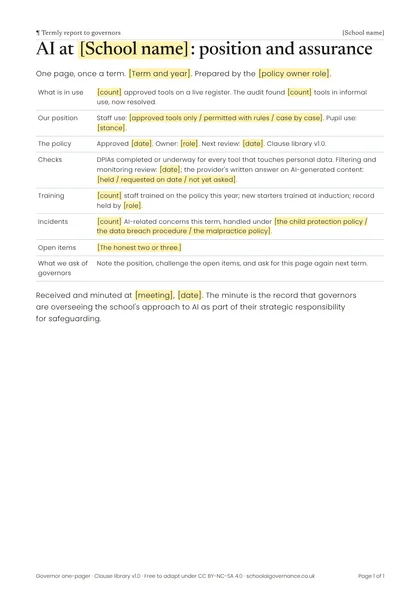
Brief governors or trustees: the audit picture, the decisions, the policy, the register, what remains open. Fifteen minutes, one page, and minuted. Governing bodies have strategic leadership responsibility for the school's safeguarding arrangements, and the minutes are the record that they were told.5 The governor one-pager is that page, written to be asked for again each term.
Put the review triggers in the diary: the annual review date, and the standing prompts, which are new statutory guidance, a new kind of tool, and any incident. A policy with a live review date is a document. One without is a commemorative plaque.
Finally, assemble the file. One folder: audit summary, decision minutes, policy, register, DPIAs and where each has got to, training logs, governor minutes, calendar entries. When the questions come, from an inspector, an auditor, a parent or a journalist, they are answered by opening it.
What this means for us
The plan survives a real school term on three principles. Audit before deciding, so the school being governed is the real one. Publish quick wins before the full policy, so risk drops while drafting goes on. And end every phase with something on paper, because in a school, if it is not written down and dated, it did not happen.
Two things that will happen #
The audit turns up a colleague who put something sensitive into a chatbot months ago. Amnesty means amnesty. The disclosure is met with thanks. The incident is still assessed on its facts as a possible data breach, because the data question does not vanish, but the person who came forward is treated as the culture the school is trying to build, not as an example to make. Go back on the amnesty once and the next audit collects silence.
A governor asks why the policy took eight weeks when templates are free online. Because the borrowed policy is a known way to fail, sometimes with the other school's name still in paragraph four. The eight weeks bought ten decisions that were decided, staff consulted on rules they will follow, and a register that matches the school's real tools. A template is a head start on the writing. The writing was never the hard part.
What changed in this guide #
November 2026: First published, written against the documents listed under Sources, each as read on the date its record shows.
Sources #
- Data protection impact assessments (DPIAs) guidance, Information Commissioner's Office
- Keeping children safe in education 2026, Department for Education, 7 July 2026
- Filtering and monitoring standards for schools and colleges (Meeting digital and technology standards in schools and colleges), Department for Education, 16 September 2026
Each source's record on the page shows the date it was read.
Free template
The facts behind this guide
Every claim above is numbered to one of these records. Each gives the source’s own words where it can, the paragraph or section, and the date it was last read.
- 01
The ICO leaves each organisation to decide who carries out its DPIAs and who signs them off. The DPO's advice should be recorded on the DPIA, with the reasons if it is not followed; the reasons should be documented whenever a DPIA is judged unnecessary; and a DPIA is a living process.
“You should record your DPO's advice on the DPIA. If you don't follow their advice, you should record your reasons”
Data protection impact assessments (DPIAs) guidance, How do we do a DPIA?. Read 28 September 2026.
- 02
Governing bodies and proprietors should ensure that a review of the effectiveness of filtering and monitoring is carried out at least once every academic year, by the SLT member responsible for filtering and monitoring with the support of the DSL and IT support, covering all internet-connected devices in all relevant locations, with a record kept of the checks. This is "should", and the consultation response says it adds no new requirement.
“ensure that a review of their effectiveness is carried out at least once every academic year”
Keeping children safe in education 2026, paragraph 173. Dated 7 July 2026. Read 8 November 2026.
- 03
The DfE's filtering and monitoring standard says the review should take place at least once every academic year, or when new technology such as generative AI tools is introduced.
“The review should take place, as a minimum, once every academic year or when … new technology is introduced, such as new devices or generative-AI (artificial intelligence) tools”
Filtering and monitoring standards for schools and colleges (Meeting digital and technology standards in schools and colleges), the core standard, "review your filtering and monitoring provision". Dated 16 September 2026. Read 28 September 2026.
- 04
The yearly review should be conducted by members of the senior leadership team, the DSL and IT support, involve the responsible governor, and be recorded with any actions.
“The yearly review should be conducted by members of the senior leadership team, the designated safeguarding lead and IT support. It should also involve the responsible governor. You should record the results of the review and document any actions taken”
Filtering and monitoring standards for schools and colleges (Meeting digital and technology standards in schools and colleges), the core standard. Dated 16 September 2026. Read 28 September 2026.
- 05
Governing bodies and proprietors have strategic leadership responsibility for their school's or college's safeguarding arrangements.
Keeping children safe in education 2026, paragraph 84 (paragraph 87 on governor training). Dated 7 July 2026. Read 8 November 2026.
Cite this guide
Wes (2026). The first hundred days: what to do, and in what order. School AI Governance, reviewed 15 November 2026. https://schoolaigovernance.co.uk/guides/first-hundred-days
Free to use, adapt and share in education under CC BY-NC-SA 4.0. Each section heading carries its own link, so a reference can point at one part.