Pupils have already made up their minds about whether staff use AI. In Public First's poll of 4,021 young people in England, carried out in August 2026, 75.6 per cent of secondary pupils thought their teachers definitely or probably use AI to plan lessons.12
So the question for a school is not whether staff use it. It is whether anyone has told them how. Every staffroom now holds one colleague who has quietly automated half their job and one who would unplug the router to be safe, and the rules have to work for both.
Nobody requires it, and nobody forbids it #
The DfE says schools and colleges "are free to make their own choices about the most suitable use cases for generative AI tools in their settings".3 Ofsted says there is no expectation that a school uses AI, that inspectors do not directly evaluate AI tools, and that what they look at is "the quality of decision-making about AI".4
That leaves the decision with the school, and the DfE's own training for staff says so. Its module tells them: "All staff should follow their organisation's guidance on which tools are permitted, particularly when it comes to student-facing AI tools."5 The module stops there, because nobody outside the school can write that guidance.
The four rules #
These are the four rules on the staff poster. Each one rests on something.
1. Nothing that identifies anyone goes into a tool that isn't approved. The DfE recommends that personal data is not used in generative AI tools.6 Its data protection guidance says to check with the DPO or IT lead before putting pupils' personal data into an AI tool, and to use only approved tools.7 No names, photos, safeguarding, SEND, medical, attendance or assessment information. Not a pupil, not a parent, not a colleague.
2. Check everything AI produces before anyone else sees it. The DfE's wording is that any content produced "requires critical judgement to check for appropriateness and accuracy", and that the quality of the final document remains the responsibility of the professional who produced it and their organisation.8 A letter home with a wrong date in it was sent by a member of staff, not by a tool.
3. School accounts on approved tools. Personal accounts are not for school work. The approved list is the school's guidance on which tools are permitted, which is the thing the DfE's module tells staff to follow.5
4. Say when AI helped. Wherever a reader would expect to know. This one is the school's own rule, not a quotation from guidance.
What stays human #
Some things deserve a person all the way through. The email to a parent about their child's difficult week. The reference. The condolence card. Anything where the reader, learning that a machine drafted it, would rightly feel short-changed. The rule of thumb to give staff: if the value of the thing is that you wrote it, write it.
Staff who hear the rules with their reasons use AI well. Staff who hear only warnings use it secretly, which is the outcome every rule exists to prevent.
Marking is the hard line #
One use has a rule of its own. For 2026/27, JCQ's General Regulations say teachers must review all of a candidate's work and determine the mark it warrants regardless of the outcome of any AI tool: "The teacher remains responsible for the mark/grade awarded."9 Ofqual says AI "may not be used as a sole marker in any assessments that are part of regulated qualifications".10
A tool may help a teacher look. It does not decide. The detail is in JCQ rules on AI in coursework.
Who owns what staff make #
A scheme of work drafted with an AI tool during the working day is still work made in the course of employment. Copyright in a work made by an employee in the course of employment belongs first to the employer, subject to any agreement to the contrary.11 That is one more reason for rule 3: resources made on a personal account sit somewhere the school cannot reach.
Training: what is required, and what is free #
KCSIE asks that all staff receive safeguarding and child protection training, including online safety and an understanding of their roles in filtering and monitoring, at induction and then "as required, and at least annually". Those paragraphs do not mention AI.12 A session on AI is the school's choice, and the annual update is the natural place for it.
The material exists and costs nothing. The DfE's "Using AI in education settings" is four modules and a leaders' pack, free, with no sign-up, under the Open Government Licence, and the DfE says they "can also be adapted".13 The Chartered College of Teaching offers a certified assessment on them with a free guest account.14
Microsoft, Google, the Raspberry Pi Foundation with Google DeepMind, and the National Centre for Computing Education also offer free AI training. All of it is either about a product or about AI as a subject, and none covers a school's own governance duties.15 That gap is what an hour of INSET on the school's own rules is for, and the INSET pack is that hour.
If the school checks what staff do with AI #
Some schools will want to look at how staff are using AI tools, through logs or monitoring software. That is monitoring of workers, and the ICO has guidance on it: an employer must carry out a DPIA before monitoring likely to cause high risk, must make sure workers are aware of the monitoring, and should seek and document the views of workers or their representatives, such as trade unions.16
Two things that will happen #
A colleague admits to pasting a class list into a free chatbot last term. The first words back, from whoever hears it, are thank you for telling me. Then it is treated as what it is: a data incident for the DPO to assess, not a confession to punish. The paste that gets reported is manageable. The paste that gets hidden is not.
A colleague asks to be excused the training because they will never use AI. Separate the two things kindly. Using AI is optional. Understanding it is not, because spotting a fake image a pupil reports, checking a colleague's AI-touched resource and knowing the four rules now fall to everyone. They can sit the session as a sceptic. Good sessions are improved by one.
Five asks, one owner each #
- The policy owner puts the four rules on one sheet, with where the approved list lives, in the staffroom and in every new starter's pack.
- Whoever keeps the register makes the approved list easy to find and says who to ask for a new tool.
- Whoever leads INSET gives the rules an hour in the annual update, and keeps the attendance log.
- The exams officer tells every teacher who marks non-examined assessment that the mark is theirs, whatever a tool suggests.
- The DPO is asked before any monitoring of staff use begins, and staff are told about it first.
What changed in this guide #
November 2026: First published, written against the documents listed under Sources, each as read on the date its record shows.
Sources #
- AI in Education: polling tables (Public First for Seldon and Bunting), Public First, 22 September 2026
- Generative artificial intelligence (AI) in education, Department for Education, 12 August 2025
- Inspection information for state-funded schools, for use from September 2026, Ofsted, 28 August 2026
- Module 3 transcript (Using AI in education settings), Department for Education
- Data protection in schools: Generative artificial intelligence (AI) and data protection in schools, Department for Education, 23 March 2026
- General Regulations for Approved Centres 2026/27, Joint Council for Qualifications, 2026/27
- Ofqual's approach to regulating the use of artificial intelligence in the qualifications sector, Ofqual, 16 July 2026
- Copyright, Designs and Patents Act 1988, section 11: First ownership of copyright, legislation.gov.uk
- Keeping children safe in education 2026, Department for Education, 7 July 2026
- Using AI in education settings: support materials, Department for Education (developed by Chiltern Learning Trust and the Chartered College of Teaching), 19 May 2026
- Britain's Greatest Education Opportunity Ever (Seldon and Bunting), Public First (hosted), 22 September 2026
- Employment practices and data protection: monitoring workers, Information Commissioner's Office, 16 June 2026
Each source's record on the page shows the date it was read.
Free template
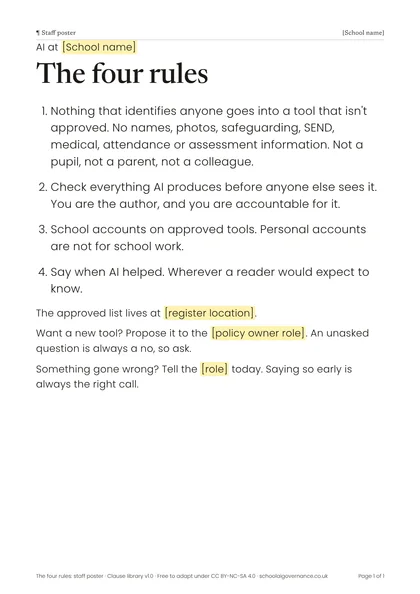
The four rules: staff poster
One A4 sheet for the staffroom and every new starter.
The facts behind this guide
Every claim above is numbered to one of these records. Each gives the source’s own words where it can, the paragraph or section, and the date it was last read.
- 01
31.5 per cent of secondary pupils and 43.3 per cent of college students agree they are better at using AI than their teachers; 75.6 per cent of both think their teachers definitely or probably use AI to plan lessons (Table 66).
AI in Education: polling tables (Public First for Seldon and Bunting), Tables 111 and 66. Dated 22 September 2026. Read 27 September 2026.
- 02
Public First's poll for the report was an online survey of 4,021 people aged 11 to 24 in England, carried out from 18 to 27 August 2026, weighted by age, gender and region. "Secondary" means Years 7 to 11; "college" means college and school sixth form. Unweighted bases: 1,326 secondary pupils and 930 college and sixth form students unless a table says otherwise.
AI in Education: polling tables (Public First for Seldon and Bunting), methodology sheet. Dated 22 September 2026. Read 27 September 2026.
- 03
The DfE says schools and colleges are free to make their own choices about the most suitable use cases for generative AI tools in their settings.
“are free to make their own choices about the most suitable use cases for generative AI tools in their settings”
Generative artificial intelligence (AI) in education, guidance text. Dated 12 August 2025. Read 28 September 2026.
- 04
Ofsted's inspection information for state-funded schools (for use from September 2026) says inspectors do not directly evaluate AI tools, there is no expectation that a school uses AI, and what they look at is the quality of decision-making about AI.
“the quality of decision-making about AI”
Inspection information for state-funded schools, for use from September 2026, the page, AI section. Dated 28 August 2026. Read 28 September 2026.
- 05
The DfE's staff module tells staff to follow their organisation's guidance on which tools are permitted, and stops there: nobody outside the school can write that guidance.
“All staff should follow their organisation's guidance on which tools are permitted, particularly when it comes to student-facing AI tools.”
Module 3 transcript (Using AI in education settings), page 7. Dated May 2026. Read 27 September 2026.
- 06
The DfE recommends that personal data is not used in generative AI tools.
“It is recommended that personal data is not used in generative AI tools”
Generative artificial intelligence (AI) in education, guidance text. Dated 12 August 2025. Read 28 September 2026.
- 07
The DfE's data protection guidance for schools has a section on generative AI, updated 23 March 2026. It says to check with the DPO or IT lead before putting pupils' personal data into an AI tool, to make sure the data is protected and not used to further train the AI, to use only approved tools, to follow the product safety standards, and to describe any AI processing in the privacy notice. It never mentions a DPIA.
“not used to further train the AI”
Data protection in schools: Generative artificial intelligence (AI) and data protection in schools, the section. Dated 23 March 2026. Read 28 September 2026.
- 08
Any content produced by generative AI requires critical judgement to check for appropriateness and accuracy, and the quality of any final document remains the responsibility of the professional who produced it and their organisation.
“Any content produced requires critical judgement to check for appropriateness and accuracy”
Generative artificial intelligence (AI) in education, guidance text. Dated 12 August 2025. Read 28 September 2026.
- 09
For 2026/27, teachers must review all of a candidate's work and determine the mark it warrants regardless of the outcome of any AI tool, and the teacher remains responsible for the mark or grade awarded. AI must not be the sole or primary means of marking.
“The teacher remains responsible for the mark/grade awarded.”
General Regulations for Approved Centres 2026/27, 5.3(b) (NEA instructions 2026/27, 6.1, says the same). Dated August 2026. Read 28 September 2026.
- 10
Ofqual's approach to regulating AI, updated 16 July 2026, says AI may not be used as a sole marker in any assessments that are part of regulated qualifications.
“AI may not be used as a sole marker in any assessments that are part of regulated qualifications.”
Ofqual's approach to regulating the use of artificial intelligence in the qualifications sector, the page. Dated 16 July 2026. Read 8 November 2026.
- 11
Copyright in a work made by an employee in the course of employment belongs first to the employer, subject to any agreement to the contrary.
“Where a literary, dramatic, musical or artistic work, or a film, is made by an employee in the course of his employment, his employer is the first owner of any copyright in the work subject to any agreement to the contrary.”
Copyright, Designs and Patents Act 1988, section 11: First ownership of copyright, section 11(2). Read 27 September 2026.
- 12
All staff should receive safeguarding and child protection training, including online safety and an understanding of their roles in filtering and monitoring, at induction, with updates as required and at least annually. The training paragraphs do not mention AI.
“as required, and at least annually”
Keeping children safe in education 2026, paragraphs 12, 153 and 154 (paragraph 12 points to 173 to 177 for filtering and monitoring). Dated 7 July 2026. Read 8 November 2026.
- 13
The DfE's "Using AI in education settings" materials are four modules and a leaders' pack, developed by the Chiltern Learning Trust and the Chartered College of Teaching, first published 10 June 2025 and updated 19 May 2026. They are free, ungated, under the Open Government Licence, and the DfE says they can also be adapted.
“can also be adapted”
Using AI in education settings: support materials, collection page. Dated 19 May 2026. Read 8 November 2026.
- 14
The DfE's Using AI in education settings materials are the furthest-reaching free offer: four modules and a leaders' pack, ungated, adaptable. The Chartered College of Teaching offers a certified assessment on them with a free guest account, worth five credits towards Chartered Status.
Using AI in education settings: support materials, collection page; chartered.college/safe-and-effective-use-of-ai-in-education. Dated 19 May 2026. Read 8 November 2026.
- 15
Microsoft (Learn and Elevate for Educators), Google (Generative AI for Educators; Gemini certification), the Raspberry Pi Foundation with Google DeepMind (Experience AI) and the NCCE (DfE-funded, via STEM Learning) offer free AI training; all are product-led or teach about AI, and none covers school-specific governance duties.
Britain's Greatest Education Opportunity Ever (Seldon and Bunting), each provider's own page (links in the timeline note). Dated 22 September 2026. Read 27 September 2026.
- 16
An employer must carry out a DPIA before monitoring likely to cause high risk, must make sure workers are aware of monitoring, and should seek and document the views of workers or their representatives, such as trade unions.
“should seek and document the views of your workers or their representatives (such as trade unions)”
Employment practices and data protection: monitoring workers, the page, 16 June 2026. Dated 16 June 2026. Read 28 September 2026.
Cite this guide
Wes (2026). Staff use of AI: four rules that fit on one sheet. School AI Governance, reviewed 15 November 2026. https://schoolaigovernance.co.uk/guides/staff-use-of-ai
Free to use, adapt and share in education under CC BY-NC-SA 4.0. Each section heading carries its own link, so a reference can point at one part.