A centre has four jobs when AI meets coursework: brief candidates on the rules before they start, accept only work its teachers can honestly authenticate, report to the awarding body any concern that surfaces after a candidate has signed the declaration, and keep a malpractice policy that covers AI. Everything else is detail about how those jobs get done.
None of it is new in principle. What moved for 2026/27 is the machinery around it: how work is marked, how exam room word processors are set up, and what awarding bodies may do with candidates' work.
For scale: in summer 2025, Ofqual counted 100 cases of plagiarism involving AI among 5,025 cases of student malpractice in GCSE, AS and A level; phones and other devices accounted for 2,225. This guide covers GCSE, AS and A level non-examination assessment (NEA) and Project qualifications; vocational qualifications have their own JCQ instructions and awarding body rules.12
What counts as misuse, and what acknowledgement involves #
JCQ calls it AI misuse when a candidate has used AI tools without properly acknowledging them and submits work that is not their own. Its examples include copying or paraphrasing AI output; using AI for parts of a task so the work no longer shows the candidate's own analysis, evaluation or calculations; and acknowledging AI poorly or not at all.3
Whether AI may be used at all depends on the assessment. JCQ's information for candidates on AI, effective from 1 September 2026, tells candidates that the rules differ between subjects and assessments, and that their teachers will say which apply.4
Where use is allowed, the NEA instructions (4.3) ask for a reference naming the tool, normally with the date the content was generated, and for the sources the tool drew on. The candidate also keeps a non-editable copy, such as screenshots, of the questions and prompts and of the AI output, adds a brief explanation of how it was used, and hands all of it in with the work, so the teacher can see where the candidate ends and the tool begins. The coursework instructions for Project qualifications say the same.5
Two points tend to surprise candidates. Acknowledged AI content is honest, but it earns no marks, because it cannot show the candidate meeting the criteria independently. And AI translation tools must not be used to generate work for assessment (NEA 4.7).67
The question to ask, in writing
For this component, may candidates use AI tools at any stage of the work, and if so, for what, and how should that use be acknowledged?
Where the specification leaves this unclear, the head of department asks the awarding body's subject team. The answer goes in the department's NEA file and into what candidates are told.
The declaration decides the route #
Where the specification requires them, two signatures sit behind each piece of NEA. The candidate's declaration of authentication confirms that the work is their own, that sources are referenced and that any use of AI is acknowledged, and it is signed only when the work is finished and handed in. The teacher confirms that the work is solely the candidate's and was done under the required conditions, and, on the 2026/27 form, that reasonable steps were taken to reduce the risk of AI misuse.8
A teacher who cannot confirm that the work is the candidate's own must not accept it: a mark of zero is recorded, and any concern about malpractice goes to a member of the senior leadership team (NEA 4.6).9
Then the switch. A concern about the content of the work, such as plagiarism or AI misuse, found before the candidate signs is dealt with under the centre's own procedures, not reported to the awarding body, though details of any work that is not the candidate's own are recorded. Breaches of the assessment conditions, such as notes taken into a supervised session, are reported whenever they are found.10
After the declaration is signed, the head of centre must notify the awarding body immediately on form JCQ/M1, and the awarding body decides the sanction, from zero for the piece of work up to disqualification from all subjects (Suspected Malpractice, 4.5; NEA section 9). The M1 asks whether the AI information sheet was issued before the declaration was signed; the answer should be yes, with a date.11
What this means for us
The declaration is the switch between a teaching conversation and a formal referral. Staff should raise doubts early, while the work is still in progress, when a concern can still be handled as teaching rather than enforcement.
Detectors are evidence, never the verdict #
JCQ does not require AI detectors. Its guidance names a few as examples, says the list is not an endorsement, and puts the principle in one sentence: “The use of detection tools, where used, should form part of a holistic approach to considering the authenticity of students' work.” All the available information has to be weighed, and the teachers who know the candidates are best placed to judge.12
Ofqual's advice note to awarding bodies (27 April 2026) agrees: such tools “should be used as sources of evidence rather than as sole determinants”, with the risk of false positives in mind. In JCQ's own illustrations of AI cases, detection software is only ever one strand, alongside a teacher's or examiner's concern, a closer reading of the work and the candidate's account.13
Young people notice when this goes wrong. In Public First polling of 4,021 people aged 11 to 24 in England (18 to 27 August 2026), 13.2 per cent of secondary pupils and 24.9 per cent of college and sixth form students said a teacher had wrongly accused them of using AI in the past year. A fifth of secondary pupils said their work goes through an AI checker, and 45.3 per cent did not know whether it does.141516
So a score goes into the file beside the drafts, the classwork and the teacher's account, and is never put to a candidate on its own.
What changed for 2026/27, including the exam room #
JCQ's main AI guidance is still Revision Two, dated 30 April 2025; the summary for teachers and the quick guide for students that go with it have editions effective from September 2026. The rule changes are in the regulations and instructions.1718
On marking, AI must not be the sole or primary means of marking, and teachers must now review all of a candidate's work and decide the mark themselves, whatever an AI tool suggests (General Regulations 5.3(b); NEA 6.1). Ofqual's approach, updated on 16 July 2026, is as plain: “AI may not be used as a sole marker in any assessments that are part of regulated qualifications.”1920
New paragraphs on candidates' work (General Regulations 6.15 to 6.24) let awarding bodies use it, including through AI-enabled tools, for essential activities such as marking, awarding and malpractice detection, with no opt-out. The centre must make sure candidates know this; candidates can opt out of other uses, such as training and research, through the centre, which must pass the notice on promptly.21
In the exam room, ICE 14.25 now says that in a paper-based exam where a candidate uses a word processor without internet access, the centre must turn off every AI tool the candidate could reach: in the word processor, in the operating system (Microsoft Copilot, Apple Intelligence and the like) and in any browser or app. AI can arrive through the application, the operating system or the network; JCQ warns that “Centres must not assume that turning one of these off is enough on its own”, and the approach must be tested before the exam.22
Smart glasses sit in the list of devices candidates must not have (ICE 18.4), and the 2026 unauthorised items poster says so in capitals. The regulator's mood is clear too: on 2 March 2026 Ofqual's Chief Regulator asked the exam boards for “a more rigorous approach to candidate and teacher authentication of work”.2324
The September calendar #
JCQ sets an order more than a date. Policy comes first: the malpractice policy must be reviewed and updated every year by a member of the senior leadership team and communicated within the centre (General Regulations 5.3(x)), and September, before any NEA starts, is the sensible moment.25
Staff come next. Everyone who teaches, supervises or marks NEA needs the subject's AI rules, the acknowledgement record, the before-and-after route, and the reminder that failing to report suspected malpractice is itself malpractice (NEA section 9). JCQ's summary for teachers makes a good handout.
Candidates come before the work begins. The information for candidates documents, the AI one included, must reach every candidate before assessments take place, and the NEA information and the declaration must be read before candidates start (General Regulations 5.8(c); NEA section 2). Ofqual's lesson plan of 9 March 2026 gives the teacher a script, and a dated record of who received what answers the M1's question before anyone asks it.262728
After that, the year runs on hand-in and the exam room: declarations signed when the work is finished and kept until reviews, appeals and any malpractice case are over, and word processors tested before every word-processed exam, with the mocks as a rehearsal.
A situation #
In February, a teacher reading a Year 11 NEA draft finds two pages that sound like nobody in the class, and a free online checker scores them at 94 per cent AI. Nothing has been signed, so this stays inside the centre: the score is not put to the candidate, and the teacher gathers what exists (earlier drafts, classwork, notes from supervised sessions) and asks the candidate to talk the section through, as a question rather than a verdict. The candidate has kept no record of any AI use, so the teacher turns to the malpractice policy with the head of department and the exams officer; the outcome is decided and recorded, and the candidate hears plainly what the declaration will mean at hand-in. Pasting candidates' work into a free checker is also a question for the DPO, before anyone tries it. Had the concern surfaced after the declaration was signed, the head of centre would be notifying the awarding body straight away.
Five asks, one owner each #
- The head of centre makes sure a senior leader reviews the malpractice policy, AI included, each September, and that any concern arising after a declaration is signed reaches the awarding body immediately on a JCQ/M1.
- The exams officer issues the information for candidates documents, the AI one included, before any NEA starts, keeps a dated record and forwards opt-out notices promptly. With IT, the exams officer also tests the AI switch-off on exam word processors before each exam.
- Heads of department get a clear answer on whether and how AI may be used in each component, in writing where the specification is unclear, and authenticate only work they are confident is the candidate's own.
- Teachers collect the AI record with the work, raise doubts before the declaration is signed, never put a detector score to a candidate on its own, and never let AI mark in their place.
- Invigilators make sure phones, watches and smart glasses are handed over before the exam starts, as ICE 18.4 and this year's poster require.
What changed in this guide #
[launch date]: First published, written against the JCQ's 2026/27 regulations and instructions, JCQ's AI Use in Assessments (Revision Two, 30 April 2025) and Ofqual's guidance, as in force on 28 September 2026.
Sources #
- AI Use in Assessments: Your role in protecting the integrity of qualifications, JCQ, Revision Two, 30 April 2025
- Preventing AI Misuse in Assessments: A summary for teachers, JCQ, effective from September 2026
- Information for candidates: AI (Artificial Intelligence and assessments), JCQ, effective from 1 September 2026
- General Regulations for Approved Centres, JCQ, effective from 1 September 2026
- Instructions for conducting non-examination assessments, JCQ, 1 September 2026 to 31 August 2027
- Instructions for conducting coursework (ELC, Project and CCEA GCE qualifications), JCQ, effective from 1 September 2026
- Instructions for conducting examinations, JCQ, 1 September 2026 to 31 August 2027
- Suspected Malpractice: Policies and Procedures, JCQ, effective from September 2026
- Unauthorised items poster, JCQ, effective from 1 September 2026
- Letter to exam board chief executives from the Chief Regulator, Ofqual, 2 March 2026
- AI in coursework: resources for schools, Ofqual, 9 March 2026
- Artificial intelligence malpractice and assessment: advice note, Ofqual, 27 April 2026
- Ofqual's approach to regulating the use of artificial intelligence in the qualifications sector, Ofqual, updated 16 July 2026
- Malpractice in GCSE, AS and A level: summer 2025 exam series, Ofqual, 11 December 2025
- Young People's Views on AI and Education, polling tables 87 and 93, Public First, 22 September 2026
Sources opened on 28 September 2026.
Free template
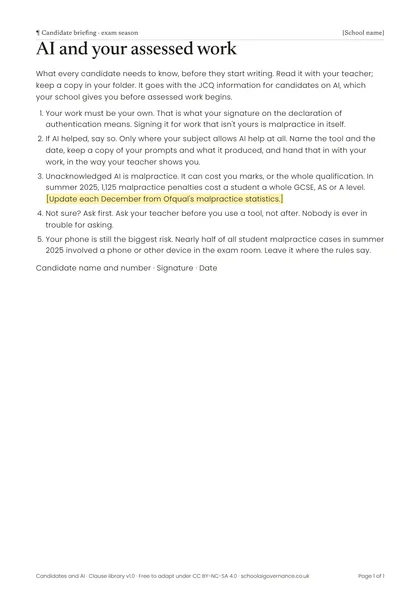
Candidates and AI
What every candidate needs to know before the work starts.
The facts behind this guide
Every claim above is numbered to one of these records. Each gives the source’s own words where it can, the paragraph or section, and the date it was last read.
- 01
Ofqual counted 100 cases of plagiarism involving AI in summer 2025, 2.0 per cent of 5,025 student malpractice cases; phones and other devices accounted for 2,225.
Malpractice in GCSE, AS and A level: summer 2025 exam series, the release, tables 6.1 to 6.5. Dated 11 December 2025. Read 28 September 2026.
- 02
In summer 2025, across GCSE, AS and A level, 1,125 malpractice penalties cost a student a whole qualification (loss of aggregation or certification opportunity) and 1,955 took marks away; 4,735 students received at least one penalty. These are penalties, not students.
Malpractice in GCSE, AS and A level: summer 2025 exam series, the release, 11 December 2025. Dated 11 December 2025. Read 28 September 2026.
- 03
JCQ calls it AI misuse when a candidate has used AI tools without properly acknowledging them and submits work that is not their own. Its examples include copying or paraphrasing AI output, using AI for parts of a task so the work no longer shows the candidate's own analysis, evaluation or calculations, and acknowledging AI poorly or not at all.
AI Use in Assessments: Your role in protecting the integrity of qualifications, AI misuse (section on what constitutes misuse). Dated 30 April 2025. Read 28 September 2026.
- 04
JCQ's "Information for candidates: AI (Artificial Intelligence and assessments)" is effective from 1 September 2026. It tells candidates the rules differ between subjects and assessments and that their teachers will say which apply. Whether it is new for 2026/27 or replaces a 2025 edition is unconfirmed.
Information for candidates: AI (Artificial Intelligence and assessments), the document. Dated 1 September 2026. Read 28 September 2026.
- 05
Where AI use is allowed, the candidate references the tool by name, normally with the date the content was generated, and the sources the tool drew on; keeps a non-editable copy (such as screenshots) of the questions and prompts and of the AI output; adds a brief explanation of how it was used; and hands all of it in with the work. The coursework instructions for Project qualifications say the same.
Instructions for conducting non-examination assessments (GCE and GCSE) 2026/27, 4.3 (and jcq-coursework-instructions-2026). Dated September 2026. Read 28 September 2026.
- 06
Acknowledged AI content earns no marks, because it cannot show the candidate meeting the assessment criteria independently ("will not be rewarded" in the AI document; "cannot be given marks" in the September 2026 summary for teachers).
AI Use in Assessments: Your role in protecting the integrity of qualifications, acknowledging AI use (and jcq-preventing-ai-misuse-teachers). Dated 30 April 2025. Read 28 September 2026. Still to be confirmed.
- 07
AI translation tools must not be used to generate work for assessment.
Instructions for conducting non-examination assessments (GCE and GCSE) 2026/27, 4.7. Dated September 2026. Read 28 September 2026.
- 08
The candidate's declaration of authentication confirms the work is their own, sources are referenced and any AI use is acknowledged, and is signed when the work is finished; the teacher confirms the work is solely the candidate's, done under the required conditions, and, on the 2026/27 form, that reasonable steps were taken to reduce the risk of AI misuse.
Instructions for conducting non-examination assessments (GCE and GCSE) 2026/27, Appendix 4. Dated September 2026. Read 28 September 2026.
- 09
A teacher who cannot confirm that the work is the candidate's own must not accept it: a mark of zero is recorded, and any concern about malpractice goes to a member of the senior leadership team.
Instructions for conducting non-examination assessments (GCE and GCSE) 2026/27, 4.6. Dated September 2026. Read 28 September 2026.
- 10
Failing to report suspected malpractice is itself malpractice. Breaches of the assessment conditions are reported whenever they are found; concerns about the content of the work found before the candidate signs are dealt with under the centre's own procedures, with details recorded.
Instructions for conducting non-examination assessments (GCE and GCSE) 2026/27, section 9 (with jcq-suspected-malpractice-2026, 4.5). Dated September 2026. Read 28 September 2026.
- 11
Once the declaration is signed, the head of centre must notify the awarding body immediately on form JCQ/M1 of any suspected malpractice, and the awarding body decides the sanction, from zero for the piece of work up to disqualification. The M1 asks whether the AI information sheet was issued before the declaration was signed.
Suspected Malpractice: Policies and Procedures, 4.5; the M1 form at Appendix 8. Dated September 2026. Read 28 September 2026.
- 12
JCQ does not require AI detection tools, names some as examples without endorsing them, and says their use should form part of a holistic approach to the authenticity of students' work, with all available information considered. A detector score is never proof on its own; JCQ does call detectors a useful part of the evidence, so "not accepted as proof of anything" overstates it.
“The use of detection tools, where used, should form part of a holistic approach to considering the authenticity of students' work”
AI Use in Assessments: Your role in protecting the integrity of qualifications, section 8, page 13. Dated 30 April 2025. Read 28 September 2026.
- 13
Ofqual's advice note to awarding bodies of 27 April 2026 says detection tools should be used as sources of evidence rather than as sole determinants, with the risk of false positives in mind.
“should be used as sources of evidence rather than as sole determinants”
Artificial intelligence malpractice and assessment: advice note, the note. Dated 27 April 2026. Read 28 September 2026.
- 14
Public First's poll for the report was an online survey of 4,021 people aged 11 to 24 in England, carried out from 18 to 27 August 2026, weighted by age, gender and region. "Secondary" means Years 7 to 11; "college" means college and school sixth form. Unweighted bases: 1,326 secondary pupils and 930 college and sixth form students unless a table says otherwise.
AI in Education: polling tables (Public First for Seldon and Bunting), methodology sheet. Dated 22 September 2026. Read 27 September 2026.
- 15
13.2 per cent of secondary pupils and 24.9 per cent of college and sixth form students say a teacher has wrongly accused them of using AI.
AI in Education: polling tables (Public First for Seldon and Bunting), Table 87. Dated 22 September 2026. Read 27 September 2026.
- 16
21.0 per cent of secondary pupils and 36.4 per cent of college students say their work goes through an AI checker; 45.3 per cent and 26.7 per cent do not know whether it does.
AI in Education: polling tables (Public First for Seldon and Bunting), Table 93. Dated 22 September 2026. Read 27 September 2026.
- 17
JCQ's AI guidance, "AI Use in Assessments: Your role in protecting the integrity of qualifications", is still Revision Two, dated 30 April 2025. There is no 2026/27 revision; JCQ issued supporting materials for September 2026 instead.
AI Use in Assessments: Your role in protecting the integrity of qualifications, title page; the JCQ AI page. Dated 30 April 2025. Read 28 September 2026.
- 18
JCQ's "Preventing AI Misuse in Assessments: A summary for teachers" is effective from September 2026 and makes a usable staff handout.
Preventing AI Misuse in Assessments: A summary for teachers, title page. Dated September 2026. Read 28 September 2026.
- 19
For 2026/27, teachers must review all of a candidate's work and determine the mark it warrants regardless of the outcome of any AI tool, and the teacher remains responsible for the mark or grade awarded. AI must not be the sole or primary means of marking.
“The teacher remains responsible for the mark/grade awarded.”
General Regulations for Approved Centres 2026/27, 5.3(b) (NEA instructions 2026/27, 6.1, says the same). Dated August 2026. Read 28 September 2026.
- 20
Ofqual's approach to regulating AI, updated 16 July 2026, says AI may not be used as a sole marker in any assessments that are part of regulated qualifications.
“AI may not be used as a sole marker in any assessments that are part of regulated qualifications.”
Ofqual's approach to regulating the use of artificial intelligence in the qualifications sector, the page. Dated 16 July 2026. Read 28 September 2026.
- 21
New for 2026/27, General Regulations 6.15 to 6.24 let awarding bodies use candidates' work, including through AI-enabled tools, for essential activities such as marking, standardisation, awarding, quality assurance and malpractice detection, with no opt-out (6.17 to 6.19). Candidates can opt out of other uses such as training, reports and research through the centre (6.20 to 6.23); the centre must tell candidates about this (6.16) and pass opt-outs on promptly (6.24).
General Regulations for Approved Centres 2026/27, 6.15 to 6.24. Dated August 2026. Read 28 September 2026.
- 22
New for 2026/27: in a paper-based exam where a candidate uses a word processor without internet access, the centre must turn off every AI tool the candidate could reach, in the word processor, the operating system (Copilot, Apple Intelligence and the like) and any browser or app; centres must not assume that turning one of these off is enough on its own, and the set-up must be tested before the exam.
“Centres must not assume that turning one of these off is enough on its own”
Instructions for conducting examinations 2026/27, 14.25 (listed in the key-changes table). Dated September 2026. Read 28 September 2026.
- 23
Candidates must not have smart glasses, phones or other unauthorised devices; candidates are responsible for handing their devices to staff (18.4(f), new wording); the 2026 unauthorised items poster says "NO SMART GLASSES".
Instructions for conducting examinations 2026/27, 18.4; Appendix 6 poster (jcq-unauthorised-items-poster-2026). Dated September 2026. Read 28 September 2026.
- 24
On 2 March 2026 (not 3 March) Ofqual's Chief Regulator wrote to exam board chief executives asking for a more rigorous approach to candidate and teacher authentication of work, and cited 1,125 cases in which students lost the entirety of a GCSE or A level.
“a more rigorous approach to candidate and teacher authentication of work”
Letter to exam board chief executives from the Chief Regulator, the letter. Dated 2 March 2026. Read 28 September 2026.
- 25
The centre's malpractice policy must be reviewed and updated every year by a member of the senior leadership team, communicated within the centre, and must acknowledge the use of AI: what AI is, when it may be used, how it is acknowledged, the risks, and how misuse is treated. The clause is 5.3(x) in 2026/27; the AI document cites it as 5.3(z), its earlier number.
“must also acknowledge the use of AI”
General Regulations for Approved Centres 2026/27, 5.3(x). Dated August 2026. Read 28 September 2026.
- 26
Centres must give candidates the JCQ information for candidates documents, the AI one included, before assessments and examinations take place.
General Regulations for Approved Centres 2026/27, 5.8(c). Dated August 2026. Read 28 September 2026.
- 27
The NEA information for candidates and the declaration must be read before candidates start assessed work.
Instructions for conducting non-examination assessments (GCE and GCSE) 2026/27, section 2. Dated September 2026. Read 28 September 2026.
- 28
Ofqual, alone, published "AI in coursework: resources for schools" on 9 March 2026: a senior leadership team briefing pack and a lesson plan. Its first action for leaders is "Speak to your exams officer". The page was updated on 7 September 2026 with no replacement materials.
“Speak to your exams officer”
AI in coursework: resources for schools, the page and the SLT briefing pack. Dated 7 September 2026. Read 28 September 2026.
Cite this guide
Wes (2026). JCQ rules on AI in coursework: what centres actually have to do. School AI Governance, reviewed 28 September 2026. https://schoolaigovernance.co.uk/guides/jcq-ai-coursework
Free to use, adapt and share in education under CC BY-NC-SA 4.0. Each section heading carries its own link, so a reference can point at one part.