Nobody makes a school write an AI policy. KCSIE 2026 does not require an AI policy, an AI strategy, a named AI lead or a stance on pupil use.1 The DfE's leadership materials say only that a school "may decide to develop an AI policy or incorporate AI use into existing policies".2 Ofsted says what inspectors look at is "the quality of decision-making about AI".3
So the case for a policy is not that someone demands it. It is that the decisions have to be written down somewhere, and that people in the building are waiting for them. In Public First's poll of young people in England in August 2026, only 21 per cent of secondary pupils said their school has rules on AI they could explain, and 22.5 per cent did not know whether AI is encouraged or banned for their homework.456
What the policy is for #
In most schools, AI use is not waiting for permission. It is happening quietly, on personal accounts, with nobody quite sure where the lines are. The policy's job is not to start something. It is to take something already happening and give it edges.
Most school policies are written to protect the school if something goes wrong. A good AI policy does that too, but its daily job is different: it answers, in advance and in writing, the questions staff are nervous about asking out loud. Can I use this for reports? What am I allowed to paste in? Do I have to tell anyone? A member of staff who has read one page of a clear policy stops second-guessing and starts working. That is the test to write to.
What this means for us
The policy is a permission slip with boundaries, not a wall. A draft that reads as a list of prohibitions will be ignored by the staff already using AI, and it will frighten the ones who most needed encouragement.
Ten decisions before a word is written #
Every school AI policy is assembled from the same parts. What varies is a small set of decisions, and once they are settled the writing is mostly transcription. These are the ten the policy builder asks.
- What kind of setting is this policy for? Primary, secondary, all-through, special or FE college. This mostly decides the pupil-use section.
- Is this for one school, or for a trust? A trust has a common core and local annexes.
- Is the school an approved exam centre? This switches the whole assessment section in or out.
- How should staff use AI? Approved tools only, permitted with rules, or case by case. The first is easiest to police. The second is the most realistic where use is already widespread.
- How should pupils use AI? No access, supervised classroom use, or permitted with disclosure, which is realistic only for older students and FE.
- Which platform does the school run on? The AI already inside a platform the school holds a data processing agreement with is usually the safest first answer to "which tool can staff use".
- Where is the school with AI right now? Exploring, piloting or embedded. This sets the tone and how often the policy is reviewed.
- Is there a working DPIA process? If not, the policy has to create one, because approving a tool depends on it.
- Who is the DPO, and who owns this policy day to day?
- Has the filtering provider confirmed, in writing, how it handles AI?
Answer those ten and the policy is specified.
The thirteen sections #
Purpose and scope. Two short paragraphs: why the policy exists, and who it covers. Cover everyone who touches school systems: staff, governors, volunteers, contractors, trainees. Resist the urge to open with a page on the transformative potential of artificial intelligence. Nobody has ever read one.
What we mean by AI. One paragraph, in ordinary words, naming the tools people know.
Roles and responsibilities. Who owns the policy, who approves tools, and where advice comes from. Name roles, not people, so the policy survives staff turnover. Say who does what in terms specific enough that everyone can point at the same sentence later.
Our position on AI. A few sentences that set the tone, from the answer to question 7.
Staff use. The heart of the policy, and where the stance lands. The DfE's staff module tells staff to "follow their organisation's guidance on which tools are permitted", so this section is that guidance.7 Whatever the stance, four rules do most of the work: nothing that identifies a pupil, parent or colleague goes into a tool that has not been approved; everything AI produces is checked by a person before anyone else sees it; school accounts on approved tools, not personal accounts; and AI use is acknowledged wherever a reader would expect to know. The first is the single sentence to train until it is reflex.
Pupil use. The tools decide part of this. The DfE says schools should comply with the age restrictions set by AI tools, and that pupils should only use generative AI with safeguards such as close supervision.8 For a primary school the position is short: pupils do not have direct access, and any classroom encounter with AI is led by the teacher and filtered. Secondary schools have real choices: supervised classroom use for specific purposes, clear rules on homework, and an expectation that pupils say when and how AI helped. That last habit is the one exam candidates are asked for later, so the school is teaching the assessment rule early.
Approved Tools Register. The policy's moving part, and the section most policies leave out. It is a live appendix listing what is approved, for whom, and for what, with a route for staff to propose additions. A policy without a register approves nothing, which in practice means everything happens anyway, unrecorded.
Personal data and AI. AI and assessments. Safeguarding, filtering and monitoring. Three short sections that mostly point at machinery that lives elsewhere. The AI policy does not duplicate the other policies; it names them and states how they connect. Two of those connections are requirements in their own right. An exam centre's malpractice policy must be reviewed every year by a member of the senior leadership team and "must also acknowledge the use of AI".9 And KCSIE says the child protection policy should cover the making or sharing of nudes and semi-nudes, "including those generated using AI".10 One page, heavily cross-referenced, beats five pages of restatement that fall out of step at the first revision.
Incidents and concerns. What to do when something goes wrong and who to tell: the existing breach and safeguarding routes, extended to AI.
Training. What staff are told, and when. KCSIE's training paragraphs ask for safeguarding and online safety training at induction and at least annually, and do not mention AI, so the commitment here is the school's own.11
Review, ownership and version history. Annually as a floor, but the real triggers are events, not dates. New DfE guidance, a new tool going onto the register, an incident, or a new JCQ edition each September: any of these reopens the policy, whatever the front cover says about annual review.
How policies fail #
Four patterns account for most of the wreckage.
The pretend ban: a policy that prohibits AI while the staffroom uses it, which teaches everyone that policies are decorative. The borrowed policy: downloaded from another school and adopted wholesale, sometimes at such speed that the other school's name is still sitting in paragraph four. The unfindable policy: written, approved, filed and never seen again, its location known only to the person who left in July. And the registerless policy: principles without a list, which answers none of the questions staff have.
Every one of these is cheaper to avoid than to repair, and all four are avoided the same way: write less, decide more, and put the register where people can find it.
Three questions that will be asked #
"So can I use AI to write my reports or not?" Yes, within the four rules. Draft with an approved tool on a school account; nothing that identifies a pupil goes into anything unapproved; every sentence is checked and owned by the teacher before it goes anywhere; and the judgements about the child are the teacher's, because that is the part of the report that is the job.
"Does the policy apply to teaching assistants?" Yes, and so does its protection. Scope covers everyone who touches school systems. The four rules read the same for all of them, which is the point: a policy with different rules for different lanyards is a policy nobody can remember.
"Why can't we just ban it?" A ban is a legitimate answer to the ten questions, so the question deserves a serious answer. A ban governs the school we imagine; the staffroom needs governing as it is. A prohibition nobody follows pushes use underground, where nobody checks the outputs, and that is the one outcome worse than no policy at all.
If only three things get done #
- The head, the DPO, the DSL, the exams officer and whoever runs IT decide the ten questions in one meeting, and the answers are minuted.
- The policy owner publishes the four staff rules and the register on one page everyone can find.
- The policy owner puts a date and an owner's role on it.
What changed in this guide #
November 2026: First published, written against the documents listed under Sources, each as read on the date its record shows.
Sources #
- Keeping children safe in education 2026, Department for Education, 7 July 2026
- Leadership toolkit video transcripts (Using AI in education settings), Department for Education
- Inspection information for state-funded schools, for use from September 2026, Ofsted, 28 August 2026
- AI in Education: polling tables (Public First for Seldon and Bunting), Public First, 22 September 2026
- Module 3 transcript (Using AI in education settings), Department for Education
- Generative artificial intelligence (AI) in education, Department for Education, 12 August 2025
- General Regulations for Approved Centres 2026/27, Joint Council for Qualifications, 2026/27
Each source's record on the page shows the date it was read.
Free template
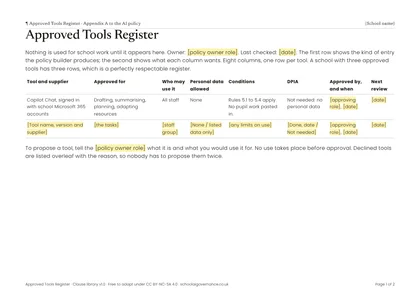
Approved Tools Register
The policy's moving part: what is approved, for whom, and for what.
The facts behind this guide
Every claim above is numbered to one of these records. Each gives the source’s own words where it can, the paragraph or section, and the date it was last read.
- 01
KCSIE 2026 does not require an AI policy, an AI strategy, a named AI lead, an AI training record, a stance on pupil use, or a ban on AI tools.
Keeping children safe in education 2026, whole document. Dated 7 July 2026. Read 8 November 2026.
- 02
The DfE's leadership materials say governors will also need support in understanding AI, which could be a specific course for governors or attending CPD in school; that a link governor for AI or digital technologies could support strategic alignment; and that a school may decide to develop an AI policy or incorporate AI use into existing policies.
“governors will also need support in understanding AI, which could be provided by a specific course for governors or them attending CPD in school”
Leadership toolkit video transcripts (Using AI in education settings), pages 25 and 29. Dated May 2026. Read 28 September 2026.
- 03
Ofsted's inspection information for state-funded schools (for use from September 2026) says inspectors do not directly evaluate AI tools, there is no expectation that a school uses AI, and what they look at is the quality of decision-making about AI.
“the quality of decision-making about AI”
Inspection information for state-funded schools, for use from September 2026, the page, AI section. Dated 28 August 2026. Read 28 September 2026.
- 04
Public First's poll for the report was an online survey of 4,021 people aged 11 to 24 in England, carried out from 18 to 27 August 2026, weighted by age, gender and region. "Secondary" means Years 7 to 11; "college" means college and school sixth form. Unweighted bases: 1,326 secondary pupils and 930 college and sixth form students unless a table says otherwise.
AI in Education: polling tables (Public First for Seldon and Bunting), methodology sheet. Dated 22 September 2026. Read 27 September 2026.
- 05
Only 21 per cent of secondary pupils say their school has rules on AI they could explain.
AI in Education: polling tables (Public First for Seldon and Bunting), Table 67. Dated 22 September 2026. Read 26 September 2026.
- 06
22.5 per cent of secondary pupils and 13.8 per cent of college students do not know whether AI is encouraged or banned for their homework.
AI in Education: polling tables (Public First for Seldon and Bunting), Table 69. Dated 22 September 2026. Read 27 September 2026.
- 07
The DfE's staff module tells staff to follow their organisation's guidance on which tools are permitted, and stops there: nobody outside the school can write that guidance.
“All staff should follow their organisation's guidance on which tools are permitted, particularly when it comes to student-facing AI tools.”
Module 3 transcript (Using AI in education settings), page 7. Dated May 2026. Read 27 September 2026.
- 08
Schools and colleges should comply with the age restrictions set by AI tools, and pupils should only use generative AI with safeguards such as close supervision and tools with safety and filtering and monitoring features.
“Schools and colleges should comply with age restrictions set by AI tools and open access LLMs”
Generative artificial intelligence (AI) in education, guidance text. Dated 12 August 2025. Read 28 September 2026.
- 09
The centre's malpractice policy must be reviewed and updated every year by a member of the senior leadership team, communicated within the centre, and must acknowledge the use of AI: what AI is, when it may be used, how it is acknowledged, the risks, and how misuse is treated. The clause is 5.3(x) in 2026/27; the AI document cites it as 5.3(z), its earlier number.
“must also acknowledge the use of AI”
General Regulations for Approved Centres 2026/27, 5.3(x). Dated August 2026. Read 28 September 2026.
- 10
The child protection policy should cover the consensual and non-consensual making or sharing of nudes and semi-nudes, including those generated using AI.
“consensual and non-consensual making or sharing of nudes and semi-nudes, including those generated using AI”
Keeping children safe in education 2026, paragraph 193 (footnote 145 to paragraph 540 repeats the point). Dated 7 July 2026. Read 8 November 2026.
- 11
All staff should receive safeguarding and child protection training, including online safety and an understanding of their roles in filtering and monitoring, at induction, with updates as required and at least annually. The training paragraphs do not mention AI.
“as required, and at least annually”
Keeping children safe in education 2026, paragraphs 12, 153 and 154 (paragraph 12 points to 173 to 177 for filtering and monitoring). Dated 7 July 2026. Read 8 November 2026.
Cite this guide
Wes (2026). Writing the school's AI policy: ten decisions, then thirteen sections. School AI Governance, reviewed 15 November 2026. https://schoolaigovernance.co.uk/guides/writing-a-school-ai-policy
Free to use, adapt and share in education under CC BY-NC-SA 4.0. Each section heading carries its own link, so a reference can point at one part.