Pupils are not waiting to be taught. In Public First's poll of 4,021 young people aged 11 to 24 in England, carried out in August 2026, 39.6 per cent of the secondary pupils who use AI had first used it aged 11 or younger.12 Only 16.7 per cent of them learned to use it from their teachers or school.3
They would like to be taught. 68.4 per cent of secondary pupils agree that young people need to be taught how to use AI, and 73.6 per cent say schools should be responsible for teaching responsible use.4
So whatever a school's stance on pupil access, it cannot take a stance on pupil understanding. Pupils are meeting these tools regardless, and at home they meet them outside the school's filter and beyond its policy. The only control that follows them home is what they know. A school that bans AI and stops there has not protected its pupils. It has made sure their first thousand hours with the technology happen unsupervised.
The rules pupils cannot repeat #
The same poll asked about school rules. Only 21 per cent of secondary pupils say their school has rules on AI they could explain.5 22.5 per cent do not know whether AI is encouraged or banned for their homework.6
A rule a pupil cannot repeat is not doing its job. Before any new lesson is planned, the cheapest piece of teaching about AI is to say the school's rules out loud, in every subject, in the words the policy uses.
What is already statutory, for secondary pupils #
The statutory RSHE guidance published in July 2025 applies to teaching from 1 September 2026.7 It puts three things about AI on the secondary timetable.
Pupils are taught that AI chatbots "can pose risks by creating fake intimacy or offering harmful advice".8 They are taught "how deepfakes can be used maliciously as well as for entertainment, the harms that can be caused by deepfakes and how to identify them".9 And they are taught that indecent images of under-18s are a crime "even if the image was created by the child and/or using AI generated imagery".10
The first of those is not a distant risk. In the same poll, 32.6 per cent of secondary pupils had used AI to talk through problems or how they are feeling.11
Two limits matter. This content sits in the secondary guidance only; the primary content does not include it.12 And the statutory requirements do not apply to sixth form colleges, 16 to 19 academies or FE colleges, although the DfE encourages them to offer the subjects.13
What this means for us
Whoever leads RSHE checks that the three points are in this year's scheme of work, and in which year group. The DSL sees those lessons before they are taught, because a lesson on deepfakes or on indecent images will prompt disclosures and staff need to know where they go.
Telling parents #
The RSHE guidance says schools should "take steps to pro-actively engage parents and make sure they are aware of what is being taught in RSHE".14 For AI, that is one letter: what the school allows, what it teaches, and who to tell if something goes wrong. The letter for parents is written for that.
Telling candidates #
For pupils taking qualifications there is a second duty, from JCQ. Staff must make sure students understand, before they start work on their assessments, the appropriate and inappropriate uses of AI, the risks, and the possible serious consequences of misuse.15 Centres must give candidates the JCQ information for candidates documents, the AI one included, before assessments and examinations take place.16 That document tells candidates the rules differ between subjects and assessments, and that their teachers will say which apply.17
So the teacher has to say. The candidate briefing is one side of A4 to read with them before they start writing.
The habit can start years earlier. A Year 7 who is taught to say what helped, and how, is practising what the exam system asks for in Year 11. Honesty rehearsed early is cheaper than malpractice discovered late.
What it looks like in the room #
None of this needs a new scheme of work. Each of these is one lesson's activity inside a subject that already exists.
Year 4. The teacher brings a printed paragraph "a computer wrote" about the Romans, the topic the class has just finished, with two planted errors. The game is to catch the computer out, and they will, gleefully, because they know the material. The lesson lands without a single technical word: computers can sound sure and still be wrong, and knowing your stuff is how you catch them.
Year 8. Two texts side by side: the textbook's account of the water cycle and an AI-generated one. Mark the AI version in three colours: sound, missing, wrong. It is English and science at once.
Year 12. Students take a question from their own subject and an AI answer to it, and write the critique: what is sound, what is biased, what is wrong, with sources. Then they draft the acknowledgement they would submit if the tool had been used in a permitted way, naming it and what it contributed. The students who can write that acknowledgement cleanly are the ones who understand where their own work begins.
The question to ask throughout is not "was this written by AI?" but "here is an AI answer; what is sound, what is biased and what is wrong?" The second teaches something. The first teaches suspicion.
What is coming in the curriculum #
The revised national curriculum is due by spring 2027, for first teaching from September 2028, and will teach AI literacy, the use of data, and bias in technology. A broader computing GCSE will replace computer science.18
That is two school years away, and the pupils in the building now will not wait for it. 45.5 per cent of secondary pupils agree they cannot tell what is AI-generated and what is not.19
Where pupils use AI in lessons #
If pupils are to use a tool in school, two conditions come from the DfE. Schools and colleges should comply with the age restrictions set by AI tools, and pupils should only use generative AI with safeguards such as close supervision and tools with safety and filtering and monitoring features.20 Teaching about AI does not need pupils to have accounts.
Two things that will happen #
A parent says: "Just tell them not to use it at home either." The school cannot filter their house, and pretending otherwise is the one answer that helps nobody. What the school can do is equip: what the tools get wrong, the habit of saying what helped, and a clear "who to tell" when something online goes wrong. The aim is a young person who uses these tools with their guard up, because that is the only version of safety that travels.
A pupil asks: "Is using AI cheating?" It depends on the claim being made. Help that is acknowledged is a tool. Help passed off as the pupil's own work is the offence, in homework now and in coursework later. Learning to state what helped, and how, is not a confession. It is the skill.
Five asks, one owner each #
- The policy owner writes the school's rules for pupils in words a Year 7 could repeat, and every teacher says them.
- Whoever leads RSHE confirms where chatbots, deepfakes and AI-generated images are taught, and shows the DSL.
- The exams officer gives every candidate the JCQ information on AI before assessed work begins, and keeps a record that it was done.
- Whoever writes to parents sends one letter saying what is allowed, what is taught and who to tell.
- The curriculum lead puts spring 2027 in the diary for the revised national curriculum.
What changed in this guide #
November 2026: First published, written against the documents listed under Sources, each as read on the date its record shows.
Sources #
- AI in Education: polling tables (Public First for Seldon and Bunting), Public First, 22 September 2026
- Relationships education, relationships and sex education (RSE) and health education (statutory guidance), Department for Education, July 2025, for teaching from 1 September 2026
- AI Use in Assessments: Your role in protecting the integrity of qualifications, Joint Council for Qualifications, effective from September 2026
- General Regulations for Approved Centres 2026/27, Joint Council for Qualifications, 2026/27
- Information for candidates: AI (Artificial Intelligence and assessments), Joint Council for Qualifications, 1 September 2026
- Government response to the Curriculum and Assessment Review, Department for Education, 5 November 2025
- Generative artificial intelligence (AI) in education, Department for Education, 12 August 2025
Each source's record on the page shows the date it was read.
Free template
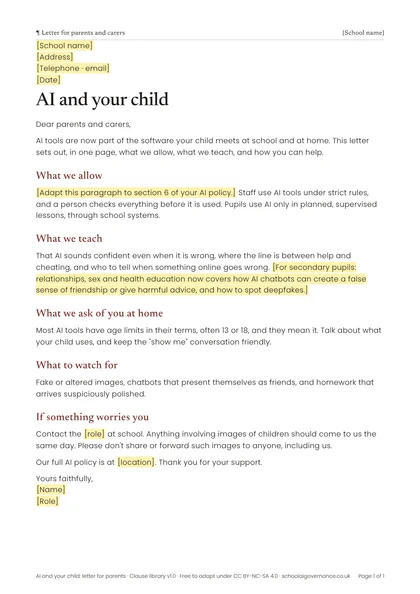
AI and your child: letter for parents
What you allow, what you teach, who to tell.
The facts behind this guide
Every claim above is numbered to one of these records. Each gives the source’s own words where it can, the paragraph or section, and the date it was last read.
- 01
Public First's poll for the report was an online survey of 4,021 people aged 11 to 24 in England, carried out from 18 to 27 August 2026, weighted by age, gender and region. "Secondary" means Years 7 to 11; "college" means college and school sixth form. Unweighted bases: 1,326 secondary pupils and 930 college and sixth form students unless a table says otherwise.
AI in Education: polling tables (Public First for Seldon and Bunting), methodology sheet. Dated 22 September 2026. Read 27 September 2026.
- 02
39.6 per cent of secondary pupils who use AI first used it aged 11 or younger (AI users only, base 1,139).
AI in Education: polling tables (Public First for Seldon and Bunting), Table 9. Dated 22 September 2026. Read 27 September 2026.
- 03
Only 16.7 per cent of secondary pupils who use AI, and 22.7 per cent of college students, learned to use it from their teachers or school (AI users only).
AI in Education: polling tables (Public First for Seldon and Bunting), Table 44. Dated 22 September 2026. Read 27 September 2026.
- 04
68.4 per cent of secondary pupils and 60.3 per cent of college students agree young people need to be taught how to use AI; 73.6 and 60.9 per cent say schools should be responsible for teaching responsible use (Table 121, up to three answers).
AI in Education: polling tables (Public First for Seldon and Bunting), Tables 102 and 121. Dated 22 September 2026. Read 27 September 2026.
- 05
Only 21 per cent of secondary pupils say their school has rules on AI they could explain.
AI in Education: polling tables (Public First for Seldon and Bunting), Table 67. Dated 22 September 2026. Read 26 September 2026.
- 06
22.5 per cent of secondary pupils and 13.8 per cent of college students do not know whether AI is encouraged or banned for their homework.
AI in Education: polling tables (Public First for Seldon and Bunting), Table 69. Dated 22 September 2026. Read 27 September 2026.
- 07
The statutory RSHE guidance published in July 2025 applies to teaching from 1 September 2026.
Relationships education, relationships and sex education (RSE) and health education (statutory guidance), publication page, updated 1 September 2026. Dated July 2025. Read 8 November 2026.
- 08
Secondary pupils are taught that AI chatbots can pose risks by creating fake intimacy or offering harmful advice.
“That AI chatbots are an example of how AI is rapidly developing, and that these can pose risks by creating fake intimacy or offering harmful advice.”
Relationships education, relationships and sex education (RSE) and health education (statutory guidance), secondary RSE, online safety and awareness, pages 15 to 17. Dated July 2025. Read 8 November 2026.
- 09
Secondary pupils are taught how deepfakes can be used maliciously as well as for entertainment, the harms they can cause, and how to identify them.
“how deepfakes can be used maliciously as well as for entertainment, the harms that can be caused by deepfakes and how to identify them”
Relationships education, relationships and sex education (RSE) and health education (statutory guidance), secondary RSE, online safety and awareness. Dated July 2025. Read 8 November 2026.
- 10
Pupils are taught that indecent images of under-18s are a crime even if the image was created by the child or using AI-generated imagery.
“even if the image was created by the child and/or using AI generated imagery”
Relationships education, relationships and sex education (RSE) and health education (statutory guidance), secondary RSE, online safety and awareness. Dated July 2025. Read 8 November 2026.
- 11
32.6 per cent of secondary pupils and 44.9 per cent of college and sixth form students have used AI to talk through problems or how they are feeling.
AI in Education: polling tables (Public First for Seldon and Bunting), Table 24 (secondary 32.57 per cent weighted, base 1,326). Dated 22 September 2026. Read 28 September 2026.
- 12
The RSHE content on AI chatbots, deepfakes and AI-generated images sits in the secondary content only. Anywhere the book or hub says pupils are taught about AI chatbots through RSHE should say secondary pupils or pupils of secondary age.
Relationships education, relationships and sex education (RSE) and health education (statutory guidance), pages 15 to 17 (secondary); primary content checked. Dated July 2025. Read 8 November 2026.
- 13
The statutory RSHE requirements do not apply to sixth form colleges, 16 to 19 academies or FE colleges, although the DfE encourages them to offer the subjects.
“The statutory requirements do not apply to sixth form colleges, 16-19 academies or Further Education (FE) colleges, although we would encourage them to support students by offering these subjects.”
Relationships education, relationships and sex education (RSE) and health education (statutory guidance), page 4. Dated July 2025. Read 8 November 2026.
- 14
Schools should take steps to proactively engage parents and make sure they are aware of what is being taught in RSHE.
“take steps to pro-actively engage parents and make sure they are aware of what is being taught in RSHE”
Relationships education, relationships and sex education (RSE) and health education (statutory guidance), page 33. Dated July 2025. Read 8 November 2026.
- 15
JCQ says teachers, assessors and other staff must make sure students, private candidates included, understand before they start work on their qualification assessments the appropriate and inappropriate use of AI, the risks of using AI and the possible serious consequences of using it inappropriately.
AI Use in Assessments: Your role in protecting the integrity of qualifications, section 4, page 5 (edition effective from September 2026). Read 15 November 2026.
- 16
Centres must give candidates the JCQ information for candidates documents, the AI one included, before assessments and examinations take place.
General Regulations for Approved Centres 2026/27, 5.8(c). Dated August 2026. Read 28 September 2026.
- 17
JCQ's "Information for candidates: AI (Artificial Intelligence and assessments)" is effective from 1 September 2026. It tells candidates the rules differ between subjects and assessments and that their teachers will say which apply; that where an AI tool is allowed its use must be acknowledged; that AI tools cannot be used in an exam, which includes the use or possession of hidden AI-enabled technology like smart glasses; and that AI misuse can lead to disqualification. JCQ's AI guidance says the sheet was published in October 2025 and must be issued to students undertaking non-examination assessment from September 2026.
Information for candidates: AI (Artificial Intelligence and assessments), the document (one page). Dated 1 September 2026. Read 15 November 2026.
- 18
The final revised national curriculum is due by spring 2027 for first teaching from September 2028, and will teach AI literacy, the use of data, and bias in technology. A broader computing GCSE will replace computer science; updated GCSEs are first taught from 2029 (some) and 2030 (the rest). The DfE has asked BCS to lead the drafting of the computing curriculum.
“aim to publish the final revised national curriculum by spring 2027”
Government response to the Curriculum and Assessment Review, pages 24, 29 and 52; the 4 November 2025 press notice. Dated 5 November 2025. Read 27 September 2026.
- 19
45.5 per cent of secondary pupils and 40.6 per cent of college students agree they cannot tell what is AI-generated and what is not.
AI in Education: polling tables (Public First for Seldon and Bunting), Table 106. Dated 22 September 2026. Read 27 September 2026.
- 20
Schools and colleges should comply with the age restrictions set by AI tools, and pupils should only use generative AI with safeguards such as close supervision and tools with safety and filtering and monitoring features.
“Schools and colleges should comply with age restrictions set by AI tools and open access LLMs”
Generative artificial intelligence (AI) in education, guidance text. Dated 12 August 2025. Read 28 September 2026.
Cite this guide
Wes (2026). Teaching pupils about AI: what is already on the timetable. School AI Governance, reviewed 15 November 2026. https://schoolaigovernance.co.uk/guides/teaching-pupils-about-ai
Free to use, adapt and share in education under CC BY-NC-SA 4.0. Each section heading carries its own link, so a reference can point at one part.