Candidates and AI
Section 9 of the AI policy; the exam malpractice policy.
The document opens on the page; press each bracket and type what goes there, and the finished Word file downloads at the end. Nothing is stored unless you save it to your account.
Download
- Word document (DOCX, 13 KB)
- PDF (PDF, 40 KB)
A4 portrait.
Free to use, adapt and share in education, under CC BY-NC-SA 4.0. No sign-up, no email address. Files are rebuilt from the text on this page at every deploy, so what you download is what you read.
The file, as text
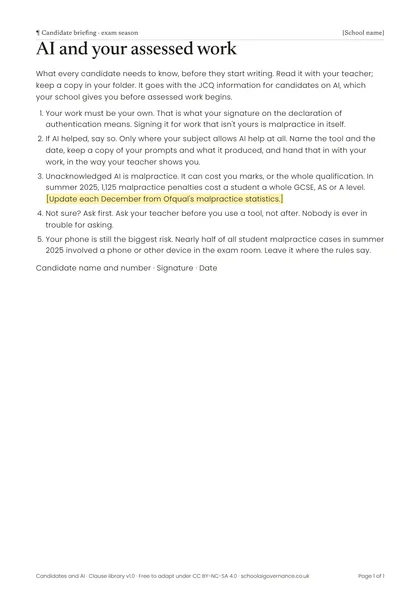
¶ Candidate briefing · exam season · [School name]
AI and your assessed work
What every candidate needs to know, before they start writing. Read it with your teacher; keep a copy in your folder. It goes with the JCQ information for candidates on AI, which your school gives you before assessed work begins.
- Your work must be your own. That is what your signature on the declaration of authentication means. Signing it for work that isn't yours is malpractice in itself.
- If AI helped, say so. Only where your subject allows AI help at all. Name the tool and the date, keep a copy of your prompts and what it produced, and hand that in with your work, in the way your teacher shows you.
- Unacknowledged AI is malpractice. It can cost you marks, or the whole qualification. In summer 2025, 1,125 malpractice penalties cost a student a whole GCSE, AS or A level. [Update each December from Ofqual's malpractice statistics.]
- Not sure? Ask first. Ask your teacher before you use a tool, not after. Nobody is ever in trouble for asking.
- Your phone is still the biggest risk. Nearly half of all student malpractice cases in summer 2025 involved a phone or other device in the exam room. Leave it where the rules say.
Candidate name and number · Signature · Date
The facts behind this template
Every claim above is numbered to one of these records. Each gives the source’s own words where it can, the paragraph or section, and the date it was last read.
- 01
The candidate's declaration of authentication confirms the work is their own, sources are referenced and any AI use is acknowledged, and is signed when the work is finished; the teacher confirms the work is solely the candidate's, done under the required conditions, and, on the 2026/27 form, that reasonable steps were taken to reduce the risk of AI misuse.
Instructions for conducting non-examination assessments (GCE and GCSE) 2026/27, Appendix 4. Dated September 2026. Read 28 September 2026.
- 02
Where AI use is allowed, the candidate references the tool by name, normally with the date the content was generated, and the sources the tool drew on; keeps a non-editable copy (such as screenshots) of the questions and prompts and of the AI output; adds a brief explanation of how it was used; and hands all of it in with the work. The coursework instructions for Project qualifications say the same.
Instructions for conducting non-examination assessments (GCE and GCSE) 2026/27, 4.3 (and jcq-coursework-instructions-2026). Dated September 2026. Read 28 September 2026.
- 03
JCQ calls it AI misuse when a candidate has used AI tools without properly acknowledging them and submits work that is not their own. Its examples include copying or paraphrasing AI output, using AI for parts of a task so the work no longer shows the candidate's own analysis, evaluation or calculations, and acknowledging AI poorly or not at all.
AI Use in Assessments: Your role in protecting the integrity of qualifications, AI misuse (section on what constitutes misuse). Dated 30 April 2025. Read 28 September 2026.
- 04
In summer 2025, across GCSE, AS and A level, 1,125 malpractice penalties cost a student a whole qualification (loss of aggregation or certification opportunity) and 1,955 took marks away; 4,735 students received at least one penalty. These are penalties, not students.
Malpractice in GCSE, AS and A level: summer 2025 exam series, the release, 11 December 2025. Dated 11 December 2025. Read 28 September 2026.
- 05
Ofqual counted 100 cases of plagiarism involving AI in summer 2025, 2.0 per cent of 5,025 student malpractice cases; phones and other devices accounted for 2,225.
Malpractice in GCSE, AS and A level: summer 2025 exam series, the release, tables 6.1 to 6.5. Dated 11 December 2025. Read 28 September 2026.
- 06
JCQ's "Information for candidates: AI (Artificial Intelligence and assessments)" is effective from 1 September 2026. It tells candidates the rules differ between subjects and assessments and that their teachers will say which apply. Whether it is new for 2026/27 or replaces a 2025 edition is unconfirmed.
Information for candidates: AI (Artificial Intelligence and assessments), the document. Dated 1 September 2026. Read 28 September 2026.
Cite this template
Wes (2026). Candidates and AI. School AI Governance. https://schoolaigovernance.co.uk/templates/candidates-and-ai
Free to use, adapt and share in education under CC BY-NC-SA 4.0. Each section heading carries its own link, so a reference can point at one part.