The Data (Use and Access) Act 2025 did not replace the data protection law schools already follow. It changed that law from the inside, by inserting new articles into the UK GDPR and new sections into the Data Protection Act 2018. The policies a school holds still stand. Some of their paragraphs need another look.
For a school using AI, four of the changes matter. One thing many people expected to change did not. And one criminal offence that has nothing to do with data protection arrived in the same Act.
Automated decisions: the change that reaches AI #
Since 5 February 2026, Articles 22A to 22D of the UK GDPR govern automated decision-making.1 Two definitions do the work. A significant decision is one with a legal or similarly significant effect on the person. A decision is solely automated when there is "no meaningful human involvement in the taking of the decision". Where both are true, people must be told, be able to make representations, obtain human intervention and contest the decision, and stricter limits apply to special category data.2
The DfE has turned that into three asks. Its compliance checklist for schools, published on 14 October 2026, asks schools to identify any systems that use automated decision-making, to "ensure a person can review decisions and change the outcome where appropriate", and to explain the use of automated decision-making in privacy notices.3
What this means for us
Start with a list. Any software that scores, ranks or flags pupils or staff goes on it, whether or not anyone calls it AI. Beside each one, write who looks at the result before anything happens to a person, and whether that look is real or a click. A real look takes the system out of "solely automated". A click does not. The discipline is short enough to say in a corridor: AI informs, people decide, and a person's name is on the decision.
Lawful basis: what did not change for a state school #
The Act created a new lawful basis, recognised legitimate interests. It is not for state schools. Neither that basis nor ordinary legitimate interests can be used by a public authority for processing in the performance of its tasks, and maintained schools, academies and FE colleges are public authorities for this purpose.4
So the footing is what it was. The ICO says public task is the lawful basis "most likely to be relevant for public authorities", with legitimate interests available to them only outside their tasks as a public authority.5 Naming the basis takes the DPO ten minutes. Not being able to name it is how conversations with the ICO start. Independent schools are not public authorities in this sense, so their position is different and wants its own advice.
The DfE now says the same about sharing. Its chapter on sharing personal data, rewritten on 13 November 2026, says the basis is identified before anything is shared, and that there should always be "a compelling reason for sharing personal data relating to children". Public task is for the school's official duties, and the DfE's example of one is "providing learning to pupils". Consent and legitimate interests are offered only for activity outside the school's core functions.6 When the chapter works through a school taking on a third-party maths tool, the names and classes go to the supplier on public task.7 A tool for teaching is the school doing what it is there to do.
A complaints route, since 19 June 2026 #
This one is new for everyone. Since 19 June 2026 controllers must have a route for data protection complaints, which means an electronic complaint form, must acknowledge a complaint within 30 days, and must respond without undue delay.8
It is a small job that is easy to miss, because nothing about AI prompts it. A parent who is unhappy about a tool their child was asked to use is the kind of complaint it exists for.
DPIAs: the test stands, the guidance is moving #
The test for a DPIA is the familiar one: it is required before processing that is likely to result in a high risk to people's rights and freedoms.9 The DfE's checklist asks schools to carry out DPIAs where required, "particularly for higher-risk processing involving" AI tools, EdTech and monitoring technologies.10
What is moving is the guidance around it. Every page of the ICO's DPIA guidance carries a banner saying that, because of changes made by the Act, the guidance is under review and may be subject to change.11 "Under review" is a status it shares with every school policy that has the words "reviewed annually" typed hopefully on the front cover. The seven steps are walked through in Does your school need a DPIA for AI tools?
The regulator has a new shape and a code to write #
On 30 September 2026 the office of Information Commissioner was abolished and its functions passed to the Information Commission. The name on a school's paperwork does not change: the regulator is still known as the ICO.12
The more useful change is still to come. Regulations in force since 12 May 2026 require the ICO to prepare a statutory code of practice on developing and using AI and automated decision-making, including guidance on children's personal data. No deadline is set.13 When it arrives it will be the document to read.
One offence that came in the same Act #
Section 138 of the Act has nothing to do with data protection and a great deal to do with schools. Creating, or requesting the creation of, a purported intimate image of an adult without consent has been an offence since 6 February 2026.14 It matters when the person targeted is a member of staff. Images of pupils are a different route altogether, set out in What KCSIE 2026 says about AI, deepfakes and filtering.
Five asks, one owner each #
- The DPO lists every system that scores, ranks or flags pupils or staff, and records who reviews its results and can change the outcome.
- Whoever keeps the privacy notice adds how automated decision-making is used, and how any data is collected, processed and stored by generative AI tools.15
- The business manager, or whoever handles complaints, checks that a data protection complaint can be made on an electronic form and is acknowledged within 30 days.
- The DPO checks the lawful basis recorded for each use of AI in the school's core work, and that none of them leans on legitimate interests.
- Whoever is introducing a new tool drafts its DPIA before it is switched on, and the DPO's advice is recorded on it.
What changed in this guide #
November 2026: Added what the DfE's chapter on sharing personal data, rewritten on 13 November 2026, says about choosing a lawful basis before sharing, and that its own example of a school taking on a maths tool rests on public task.
November 2026: First published, written against the documents listed under Sources, each as read on the date its record shows.
Sources #
- The Data (Use and Access) Act 2025 (Commencement No. 6 and Transitional and Saving Provisions) Regulations 2026, SI 2026/82, legislation.gov.uk, 29 January 2026
- UK GDPR, Articles 22A to 22D: automated decision-making, legislation.gov.uk, 5 February 2026
- Data protection in schools: Data (Use and Access) Act 2025 (DUAA): compliance checklist for schools, Department for Education, 14 October 2026
- UK GDPR, Article 6: Lawfulness of processing, legislation.gov.uk, 5 February 2026
- Lawful basis: public task, Information Commissioner's Office, 28 August 2026
- UK GDPR, Article 35: Data protection impact assessment, legislation.gov.uk
- Data protection impact assessments (DPIAs) guidance, Information Commissioner's Office
- ICO governance changes confirmed for 30 September 2026, Information Commissioner's Office, 17 September 2026
- Regulations requiring the ICO to prepare a code of practice on AI and automated decision-making, SI 2026/425, legislation.gov.uk, 16 April 2026
- The Data (Use and Access) Act 2025 (Commencement No. 5) Regulations 2026, SI 2026/31, legislation.gov.uk, 15 January 2026
- Data protection in schools: Generative artificial intelligence (AI) and data protection in schools, Department for Education, 23 March 2026
- Data protection in schools: Sharing personal data, Department for Education, chapter rewritten 13 November 2026
Each source's record on the page shows the date it was read.
Free template
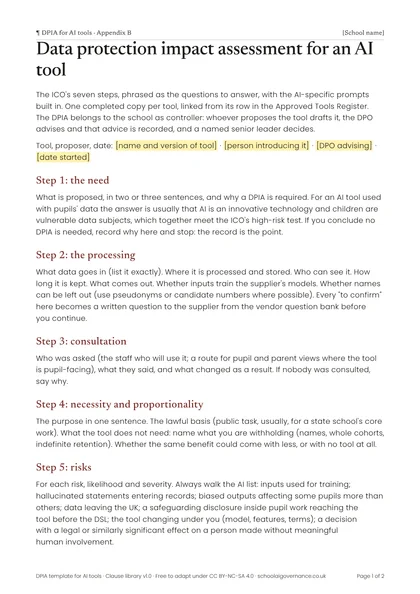
DPIA template for AI tools
The ICO's seven steps as questions to answer, with the usual AI risks already listed.
The facts behind this guide
Every claim above is numbered to one of these records. Each gives the source’s own words where it can, the paragraph or section, and the date it was last read.
- 01
Section 80 of the Data (Use and Access) Act 2025 (automated decision-making) came into force on 5 February 2026, with the Act's main data protection changes.
The Data (Use and Access) Act 2025 (Commencement No. 6 and Transitional and Saving Provisions) Regulations 2026, SI 2026/82, regulation 2(j). Dated 29 January 2026. Read 28 September 2026.
- 02
Since 5 February 2026, UK GDPR Articles 22A to 22D (inserted by section 80 of the Data (Use and Access) Act 2025) govern automated decision-making. A significant decision is one with a legal or similarly significant effect on the person; a decision is solely automated when there is no meaningful human involvement in taking it. People must be told, be able to make representations, obtain human intervention and contest the decision; stricter limits apply to special category data.
“no meaningful human involvement in the taking of the decision”
UK GDPR, Articles 22A to 22D: automated decision-making, Articles 22A to 22D; commencement by SI 2026/82, regulation 2(j). Dated 5 February 2026. Read 28 September 2026.
- 03
The same checklist asks schools to identify any systems that use automated decision-making, to ensure a person can review decisions and change the outcome where appropriate, and to explain the use of automated decision-making in privacy notices.
“ensure a person can review decisions and change the outcome where appropriate”
Data protection in schools: Data (Use and Access) Act 2025 (DUAA): compliance checklist for schools, Automated decision-making and AI. Dated 14 October 2026. Read 8 November 2026.
- 05
Public task is the lawful basis most likely to be relevant for public authorities; legitimate interests is available to them only outside their tasks as a public authority. For a state school, academy trust or college doing its core work the basis is usually public task. The DfE names no usual basis, and the 2025 Act does not "confirm this footing for schools directly".
“most likely to be relevant for public authorities”
Lawful basis: public task, the page, updated 28 August 2026. Dated 28 August 2026. Read 28 September 2026.
- 06
Before sharing any personal data a school needs to identify the lawful basis, and should always have a compelling reason for sharing personal data relating to children. The DfE says schools are most likely to rely on public task, where the school needs to use or share personal data to carry out its official duties such as providing learning to pupils; on consent, if the activity is not part of its core functions and consent is needed to share; or on legitimate interests, if the activity is not part of its core functions and the school or a third party has legitimate interests. Depending on the purpose of the sharing, schools can also rely on contract, legal obligation or vital interests.
“You should always have a compelling reason for sharing personal data relating to children.”
Data protection in schools: Sharing personal data, the section How to decide the most appropriate lawful basis. Dated 13 November 2026. Read 15 November 2026.
- 07
The DfE's example of sharing personal data to use an EdTech tool: a school that has decided to use a third-party maths tool consults its data protection officer and makes sure it has the appropriate agreements in place with the organisation; it shares teaching staff names and email addresses and pupil names and class details, the minimum needed to create accounts and provide content, on the lawful basis of public task; and the privacy notice is updated and parents and carers are told how the pupils' personal data will be processed.
Data protection in schools: Sharing personal data, the section Sharing data with other organisations, in the example headed Sharing personal data to use EdTech tools. Dated 13 November 2026. Read 15 November 2026.
- 08
Since 19 June 2026 controllers must have a route for data protection complaints (an electronic complaint form), acknowledge a complaint within 30 days and respond without undue delay (Data Protection Act 2018 section 164A, inserted by section 103 and Schedule 10 of the 2025 Act).
The Data (Use and Access) Act 2025 (Commencement No. 6 and Transitional and Saving Provisions) Regulations 2026, SI 2026/82, regulation 3(a); DPA 2018 section 164A. Dated 29 January 2026. Read 28 September 2026.
- 09
A DPIA is required before processing that is likely to result in a high risk to people's rights and freedoms, in particular where new technologies are used. It is not required before every tool that processes pupil data.
“in particular using new technologies”
UK GDPR, Article 35: Data protection impact assessment, Article 35(1). Read 28 September 2026.
- 10
The DfE's Data (Use and Access) Act 2025 compliance checklist for schools, published 14 October 2026 as a chapter of Data protection in schools, asks schools to carry out DPIAs where required, particularly for higher-risk processing involving AI tools, EdTech and monitoring technologies.
“carry out Data Protection Impact Assessments (DPIAs) where required, particularly for higher-risk processing involving”
Data protection in schools: Data (Use and Access) Act 2025 (DUAA): compliance checklist for schools, Children's data and safeguarding. Dated 14 October 2026. Read 8 November 2026.
- 11
The ICO's DPIA guidance carries the banner "Due to changes made by the Data (Use and Access) Act, this guidance is under review and may be subject to change", with no visible last-updated date. Re-check at launch.
Data protection impact assessments (DPIAs) guidance, every DPIA page. Read 28 September 2026.
- 12
On 30 September 2026 the office of Information Commissioner is abolished and its functions pass to the Information Commission (sections 118 and 119 of the 2025 Act, commenced by SI 2026/1015). The regulator will continue to be known as the ICO. Paul Arnold is interim chief executive and a chair is being recruited.
“As the Information Commission's Office, we will continue to be known as the ICO.”
ICO governance changes confirmed for 30 September 2026, ICO news, 15 September 2026, updated 17 September; SI 2026/1015 made 10 September 2026; HCWS337, 14 September 2026. Dated 17 September 2026. Read 28 September 2026.
- 13
Regulations in force since 12 May 2026 (SI 2026/425, under sections 124A and 124B of the Data Protection Act 2018) require the ICO to prepare a statutory code of practice on developing and using AI and automated decision-making, including guidance on children's personal data. No deadline is set.
Regulations requiring the ICO to prepare a code of practice on AI and automated decision-making, SI 2026/425, the regulations. Dated 16 April 2026. Read 28 September 2026.
- 14
Creating, or requesting the creation of, a purported intimate image of an adult without consent has been an offence since 6 February 2026 (Sexual Offences Act 2003 sections 66E and 66F, inserted by section 138 of the Data (Use and Access) Act 2025). It matters when a member of staff is targeted.
The Data (Use and Access) Act 2025 (Commencement No. 5) Regulations 2026, SI 2026/31, SI 2026/31, made 15 January 2026; DUAA 2025 section 138. Dated 15 January 2026. Read 28 September 2026.
- 15
Schools must include how any data is collected, processed and stored by generative AI tools in their privacy notice.
“include how any data is collected, processed and stored by generative AI tools in your school's privacy notice”
Data protection in schools: Generative artificial intelligence (AI) and data protection in schools, the section. Dated 23 March 2026. Read 28 September 2026.
Cite this guide
Wes (2026). The Data (Use and Access) Act, for people who run schools. School AI Governance, reviewed 15 November 2026. https://schoolaigovernance.co.uk/guides/data-use-and-access-act-schools
Free to use, adapt and share in education under CC BY-NC-SA 4.0. Each section heading carries its own link, so a reference can point at one part.