A school that buys an AI tool is trusting a supplier with its pupils' and staff's data. The regulator has looked at how well that trust is placed. The ICO's audits of edtech providers, reported on 24 June 2026, found that in many cases providers "hadn't done a DPIA at all where one was required", that some switched new features on by default, and that AI functionality had been introduced without adequate safeguards.1
None of that moves the responsibility. For most personal data in a school the controller is, in the DfE's words, "the school or the multi-academy trust".2 The supplier answers for its product. The school answers for choosing it.
One habit of mind carries the rest: a supplier's claim is marketing until it is in the contract. Every AI product on earth is described as fully GDPR compliant, a phrase that appears on precisely all of them and guarantees nothing.
What the DfE asks for before purchase #
On 9 July 2026 the DfE added a section on procuring educational technology to its data protection guidance for schools. It asks for four things. A DPIA must be completed when processing is likely to result in a high risk, as early as possible, with the DPO's advice, and kept updated as the processing changes. Suppliers must be able to explain how their tool works, including how the AI's outputs are moderated and whether data is used to train the model. The DPO and the DSL must be consulted before purchase. And tools must be monitored after it.3
What this means for us
Two people see the tool before the order goes in: the DPO and the DSL. Not after the trial, and not once the invoice has arrived. The simplest way to make that happen is for nothing to be bought or switched on until it has a line on the approved tools register with both names against it.
The bar: the product safety standards #
The DfE's product rules for generative AI are called "Generative AI: product safety standards". They were first published as expectations on 22 January 2025, then renamed and extended on 19 January 2026 with new standards on cognitive development, emotional and social development, mental health, and manipulation.4
They are written for suppliers, not for schools. The DfE says schools and colleges "may also find them helpful in assessing which AI products are safe for use in education".5 That is the right way to use them: as the bar a supplier should be able to show it clears.
Two of the standards are worth knowing by heart. A product for learners should avoid "attempting to cultivate personal relationships with users", should not present itself as a person, should avoid the potential for emotional dependence, and should alert the DSL to patterns that suggest it.6 And a product must not store, collect or use intellectual property created by learners or teachers for any commercial purpose, such as training or fine-tuning models, unless the copyright owner consents. The standards say nothing about who owns prompts or outputs, so the contract has to.7
Training on pupils' work is the school's duty too #
The rule on training does not sit only with the supplier. The DfE says schools and colleges "must not allow or cause students' original work to be used to train generative AI models unless they have permission", and that permission comes from the student as copyright owner, or from a parent or guardian where the student is a minor.8 Its data protection guidance says the same from the other side: make sure the data is protected and "not used to further train the AI", and use only approved tools.9
So "is our data used to train your models?" is not a courtesy question. If the answer is yes, or vague, the school is the one allowing it.
The Children's code is the supplier's, not the school's #
Suppliers sometimes point to the ICO's Children's code as if it were the school's to meet. It is not. Schools are not in scope of the code; the duty falls on the providers of online services children are likely to use.10 The DfE puts it the same way: schools are "not directly in scope", though the edtech they buy often is.11 It is a fair thing to ask a supplier how it meets the code. It is the supplier's answer to give.
Ask in writing #
The questions are in the Vendor question bank: sixteen of them, on what data the tool takes, where it goes, whether it trains anything, how the AI's output is moderated, who owns what, and what happens on the way out. Ask in writing, require plain-language answers, and treat vagueness as an answer. Tick when the answer is in the contract, not the call.
Demos prove less than they feel like they prove; the demo account has never met a Year 9. And a reassuring call is worth what it sounds like. The contract is the control, the register entry is the record, and the DPIA is the thinking. A charming account manager is none of those things.
Check the age the tool sets for its users before anything else. The DfE says schools and colleges should comply with the age restrictions set by AI tools, and that pupils should only use generative AI with safeguards such as close supervision and tools with safety and filtering and monitoring features.12 A tool whose own terms exclude the year group it is wanted for is declined at the first question.
What the paperwork should cover #
The DfE has since said what it expects on paper. Its chapter on sharing personal data, rewritten on 13 November 2026, says that routine sharing outside the school must have appropriate documentation in place, which could include a data sharing agreement. It lists what such an agreement should define: who is responsible for what, why the data is being shared, which data, the lawful basis, how individual rights requests are handled, and what happens after a personal data breach.13 Those six make a fair list to hold a supplier's contract against. A contract that is silent on one of them has told the school something.
The same chapter has an example to measure a purchase against. A school taking on a third-party maths tool consults its DPO and has the agreements in place with the supplier. It shares teachers' names and email addresses and pupils' names and classes, which the DfE calls "the minimum amount of data required to create accounts and provide content", on the lawful basis of public task. Then it updates the privacy notice and tells parents and carers.14 A tool that asks for more than that to do the same job has a question to answer, in writing.
After the purchase #
Monitoring after purchase is one of the DfE's four asks, and suppliers change their products. The ICO's audits found features switched on by default.1 "It came with the update" is how AI arrives without anyone having decided to have it. Three habits keep a school ahead of that. The register entry carries a review date. The DPIA is opened again when the tool changes. And the annual filtering and monitoring review records how and where generative AI products are used, including inside other applications.15
The privacy notice follows the register: schools must include in it how any data is collected, processed and stored by generative AI tools.16
What is coming #
The DfE has promised that ministers will consult, later in 2026, on new independent safety certification for some types of technology used in schools, including generative AI and filtering and monitoring products.17 Until a certificate exists, the questions are the certificate.
Two things that will happen #
A supplier answers the training question with a link to its privacy policy. That is a non-answer wearing a hyperlink. Whoever is running the purchase replies in writing: "Please confirm, yes or no, whether our data is used to train, fine-tune, test or improve your models, and where in the contract that commitment sits." A direct question that cannot get a direct answer has been answered, and the register entry says so.
A department has bought an AI subscription on a school card without asking anyone. No theatre required. The tool joins the queue like any other: the questions, the standards, and a DPIA if it touches personal data. If it passes, it goes on the register and the department keeps its tool, now with the school behind it. If it fails, the subscription ends, and the route for proposing a tool gets advertised again, because this is what that route exists to prevent.
Five asks, one owner each #
- Whoever wants the tool sends the supplier the sixteen questions in writing before any trial with real data.
- The DPO reads the answers, advises on the DPIA, and that advice is recorded on it.
- The DSL reads the answers on moderation, age and emotional dependence, and says yes or no for pupils.
- Whoever approves tools records the outcome on the register: approved, approved with conditions, or declined, with the telling answers attached.
- Whoever keeps the register sets a review date and reopens the entry when the supplier changes the product.
What changed in this guide #
November 2026: Added what the DfE's chapter on sharing personal data, rewritten on 13 November 2026, says about the paperwork for routine sharing and what a data sharing agreement should define, and the DfE's own example of a school taking on a maths tool.
November 2026: First published, written against the documents listed under Sources, each as read on the date its record shows.
Sources #
- Edtech examined (audit outcomes report), Information Commissioner's Office, 24 June 2026
- Data protection in schools, Department for Education, guidance last updated 13 November 2026
- Data protection in schools: Procuring educational technology (EdTech), Department for Education, 9 July 2026
- Generative AI: product safety standards, Department for Education, 19 January 2026
- Generative artificial intelligence (AI) in education, Department for Education, 12 August 2025
- Data protection in schools: Generative artificial intelligence (AI) and data protection in schools, Department for Education, 23 March 2026
- The Children's code and education technologies (edtech), Information Commissioner's Office
- Filtering and monitoring standards for schools and colleges (Meeting digital and technology standards in schools and colleges), Department for Education, 16 September 2026
- New guidance on screen use for children aged 5 to 16 (press notice), Department for Education, 10 September 2026
- Data protection in schools: Sharing personal data, Department for Education, chapter rewritten 13 November 2026
Each source's record on the page shows the date it was read.
Free template
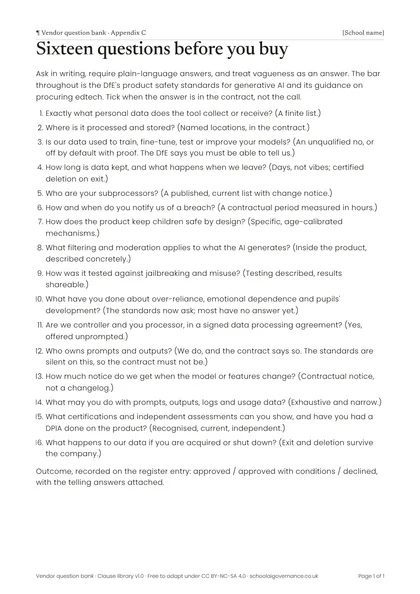
Vendor question bank
Sixteen questions to send in writing before any new tool is bought or switched on.
The facts behind this guide
Every claim above is numbered to one of these records. Each gives the source’s own words where it can, the paragraph or section, and the date it was last read.
- 01
The ICO's audits of edtech providers, reported on 24 June 2026, found that in many cases providers had not done a DPIA at all where one was required, that some switched new features on by default, and that AI functionality had been introduced without adequate safeguards.
“hadn't done a DPIA at all where one was required”
Edtech examined (audit outcomes report), page 14. Dated 24 June 2026. Read 28 September 2026.
- 02
For most personal data in a school the controller is, in the DfE's words, the school or the multi-academy trust.
“the school or the multi-academy trust”
Data protection in schools, Responsibilities. Dated 13 November 2026. Read 15 November 2026.
- 03
A section on procuring educational technology was added on 9 July 2026. It says a DPIA must be completed when processing is likely to result in a high risk, as early as possible, with the DPO's advice, and kept updated as and when the processing changes; suppliers must be able to explain how their tool works, including how AI outputs are moderated and whether data is used to train the model; the DPO and DSL must be consulted before purchase; and tools must be monitored after it.
“Suppliers must be able to explain how their tool works, including: how the AI (artificial intelligence) outputs are moderated; if the data is used to train the AI (artificial intelligence) model”
Data protection in schools: Procuring educational technology (EdTech), the section. Dated 9 July 2026. Read 28 September 2026.
- 04
The DfE's product rules for generative AI are now "Generative AI: product safety standards". First published as expectations on 22 January 2025, they were renamed and extended on 19 January 2026 with new standards on cognitive development, emotional and social development, mental health, and manipulation.
“to include new standards on cognitive development, emotional and social development, mental health, and manipulation”
Generative AI: product safety standards, publication page, change history. Dated 19 January 2026. Read 28 September 2026.
- 05
The standards are written for edtech developers and suppliers; the DfE says schools and colleges may also find them helpful in assessing which AI products are safe for use in education. That is softer than "schools can use them to judge what is safe to buy".
“These standards are for edtech developers and suppliers to schools and colleges. Schools and colleges may also find them helpful in assessing which AI products are safe for use in education.”
Generative AI: product safety standards, introduction. Dated 19 January 2026. Read 28 September 2026.
- 06
Learner-facing products should avoid attempting to cultivate personal relationships with users, should not anthropomorphise, should avoid the potential for emotional dependence, and should alert the DSL to patterns that suggest emotional dependence.
“attempting to cultivate personal relationships with users”
Generative AI: product safety standards, emotional and social development; mental health. Dated 19 January 2026. Read 28 September 2026.
- 07
A product must not store, collect or use intellectual property created by learners, teachers or the copyright owner for any commercial purpose, such as training or fine-tuning models, unless the copyright owner consents. The standards say nothing about who owns prompts or outputs.
“must not store, collect or use intellectual property created by learners, teachers, or the copyright owner for any commercial purposes, such as training or fine tuning of models, unless consented to by the copyright owner”
Generative AI: product safety standards, intellectual property. Dated 19 January 2026. Read 28 September 2026.
- 08
Schools and colleges must not allow or cause students' original work to be used to train generative AI models unless they have permission, which comes from the student as copyright owner or from a parent or guardian where the student is a minor.
“must not allow or cause students' original work to be used to train generative AI models unless they have permission”
Generative artificial intelligence (AI) in education, intellectual property. Dated 12 August 2025. Read 28 September 2026.
- 09
The DfE's data protection guidance for schools has a section on generative AI, updated 23 March 2026. It says to check with the DPO or IT lead before putting pupils' personal data into an AI tool, to make sure the data is protected and not used to further train the AI, to use only approved tools, to follow the product safety standards, and to describe any AI processing in the privacy notice. It never mentions a DPIA.
“not used to further train the AI”
Data protection in schools: Generative artificial intelligence (AI) and data protection in schools, the section. Dated 23 March 2026. Read 28 September 2026.
- 10
Schools are not information society services and are not in scope of the ICO's Children's code; the duty to meet the code falls on the providers of online services children are likely to use.
“schools are not Information Society Services (ISS) and are not in scope of the Children's code”
The Children's code and education technologies (edtech), the page. Read 28 September 2026.
- 11
The DfE's procurement section says schools are not directly in scope of the ICO's Children's code, though the edtech they buy often is.
“not directly in scope”
Data protection in schools: Procuring educational technology (EdTech), the section. Dated 9 July 2026. Read 28 September 2026.
- 12
Schools and colleges should comply with the age restrictions set by AI tools, and pupils should only use generative AI with safeguards such as close supervision and tools with safety and filtering and monitoring features.
“Schools and colleges should comply with age restrictions set by AI tools and open access LLMs”
Generative artificial intelligence (AI) in education, guidance text. Dated 12 August 2025. Read 28 September 2026.
- 13
When a school routinely shares personal data outside the school, there must be appropriate documentation in place, which could include a data sharing agreement. The DfE says such an agreement should define the roles and responsibilities of the organisations involved, the aims and purposes of the sharing, the personal data to be shared including any special category data, the lawful basis, the procedures for individual rights requests, and information governance such as responding to a personal data breach.
Data protection in schools: Sharing personal data, the section Appropriate documentation to support a data share. Dated 13 November 2026. Read 15 November 2026.
- 14
The DfE's example of sharing personal data to use an EdTech tool: a school that has decided to use a third-party maths tool consults its data protection officer and makes sure it has the appropriate agreements in place with the organisation; it shares teaching staff names and email addresses and pupil names and class details, the minimum needed to create accounts and provide content, on the lawful basis of public task; and the privacy notice is updated and parents and carers are told how the pupils' personal data will be processed.
Data protection in schools: Sharing personal data, the section Sharing data with other organisations, in the example headed Sharing personal data to use EdTech tools. Dated 13 November 2026. Read 15 November 2026.
- 15
The annual review should establish how and where any generative AI web and in-application products are used, and any technical limitations, such as whether the solution can monitor and filter real-time, dynamic, personalised or AI-generated content.
“how and where any generative AI web and in-application products are used”
Filtering and monitoring standards for schools and colleges (Meeting digital and technology standards in schools and colleges), the core standard, review checklist. Dated 16 September 2026. Read 28 September 2026.
- 16
Schools must include how any data is collected, processed and stored by generative AI tools in their privacy notice.
“include how any data is collected, processed and stored by generative AI tools in your school's privacy notice”
Data protection in schools: Generative artificial intelligence (AI) and data protection in schools, the section. Dated 23 March 2026. Read 28 September 2026.
- 17
The DfE has promised that later in 2026 ministers will consult on new independent safety certification for some types of technology used in schools, including generative AI and filtering and monitoring products, and that screen-use guidance for 5 to 16-year-olds will be published in autumn 2026.
“Later this year, ministers will consult on new independent safety certification for some types of technology used in schools, including generative AI and filtering and monitoring products.”
New guidance on screen use for children aged 5 to 16 (press notice), press notice, 8 June 2026, updated 10 September 2026. Dated 10 September 2026. Read 27 September 2026.
Cite this guide
Wes (2026). Buying an AI tool: what to ask before the school signs. School AI Governance, reviewed 15 November 2026. https://schoolaigovernance.co.uk/guides/buying-ai-tools-for-schools
Free to use, adapt and share in education under CC BY-NC-SA 4.0. Each section heading carries its own link, so a reference can point at one part.